


Disclosure: My website is reader supported. If you purchase a product after clicking a link, I may receive a commission, at no extra cost to you. Learn more.
Overview
In the video above, I share my experience of using the Chilipad Dock Pro bed cooling and heating system for over half a year. I also revisit some important points from my previous in-depth Dock Pro review.
I filmed it in early 2025, but I’ve updated this article in August 2026 to include even more updates and my early thoughts on the latest model, which I’m currently testing and plan on reviewing in time.
You can read the video transcript below if you prefer, or jump to the end for the link to the company’s website and all my updates.
Name change
In 2026, SleepMe renamed the Chilipad Dock Pro to Chilipad 1.0. This is to be in line with their new model, the Chilipad 2.0, which is a direct evolution of the Dock Pro. The transcript below keeps the Dock Pro reference to be in line with my video. But the Chilipad 2.0 update section at the end uses the new name.
Video transcript
Please note that I made some small edits to the transcript so it’s easier to read.
Introduction
A few months ago, I published an in-depth review of the Chilipad Dock Pro bed cooling and heating system, but I’ve continued using it since then. I’ve actually been using it for over 200 nights now.
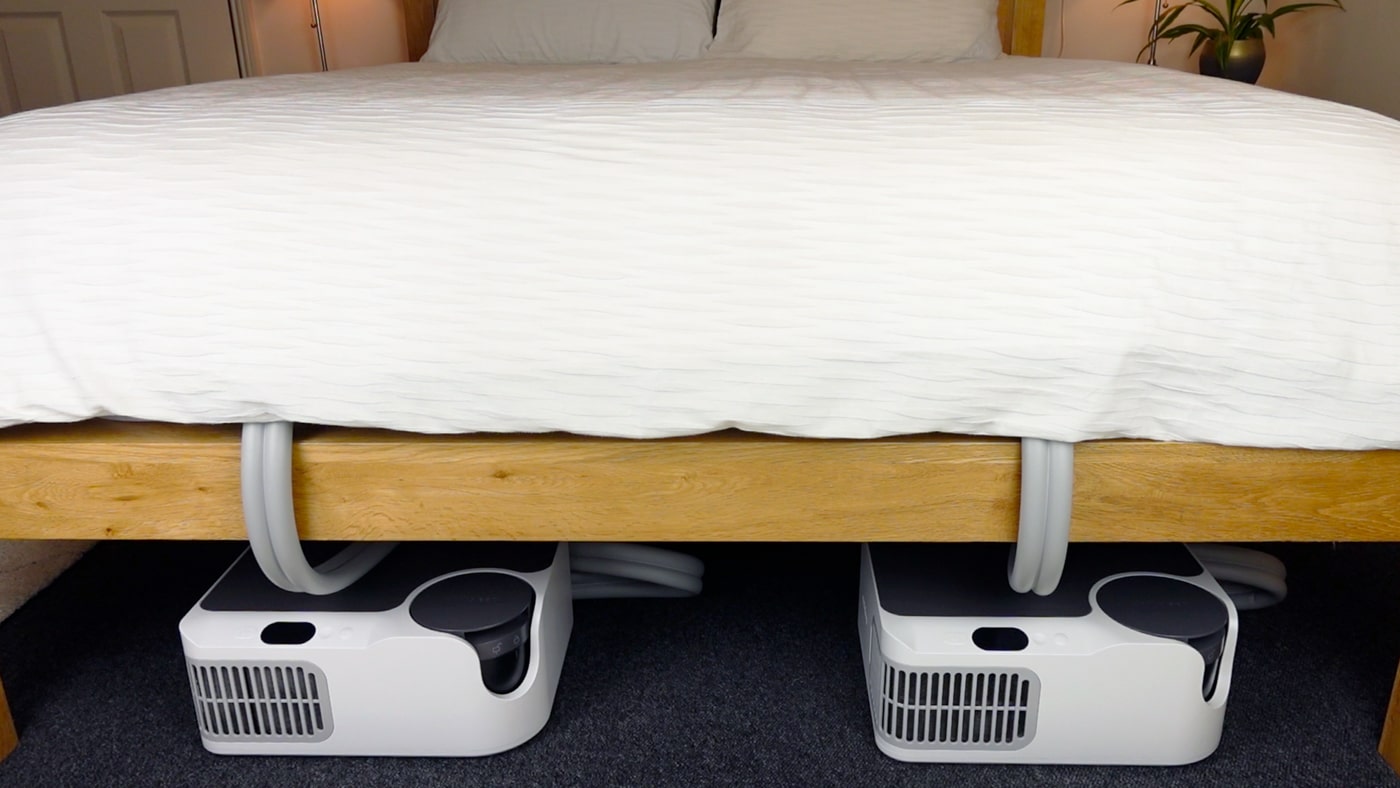
In the photo below, you can see the size of the Dock Pro base units that ideally fit under the bed. Keep in mind that I’m quite tall when judging the dimensions of the units and water tubes.
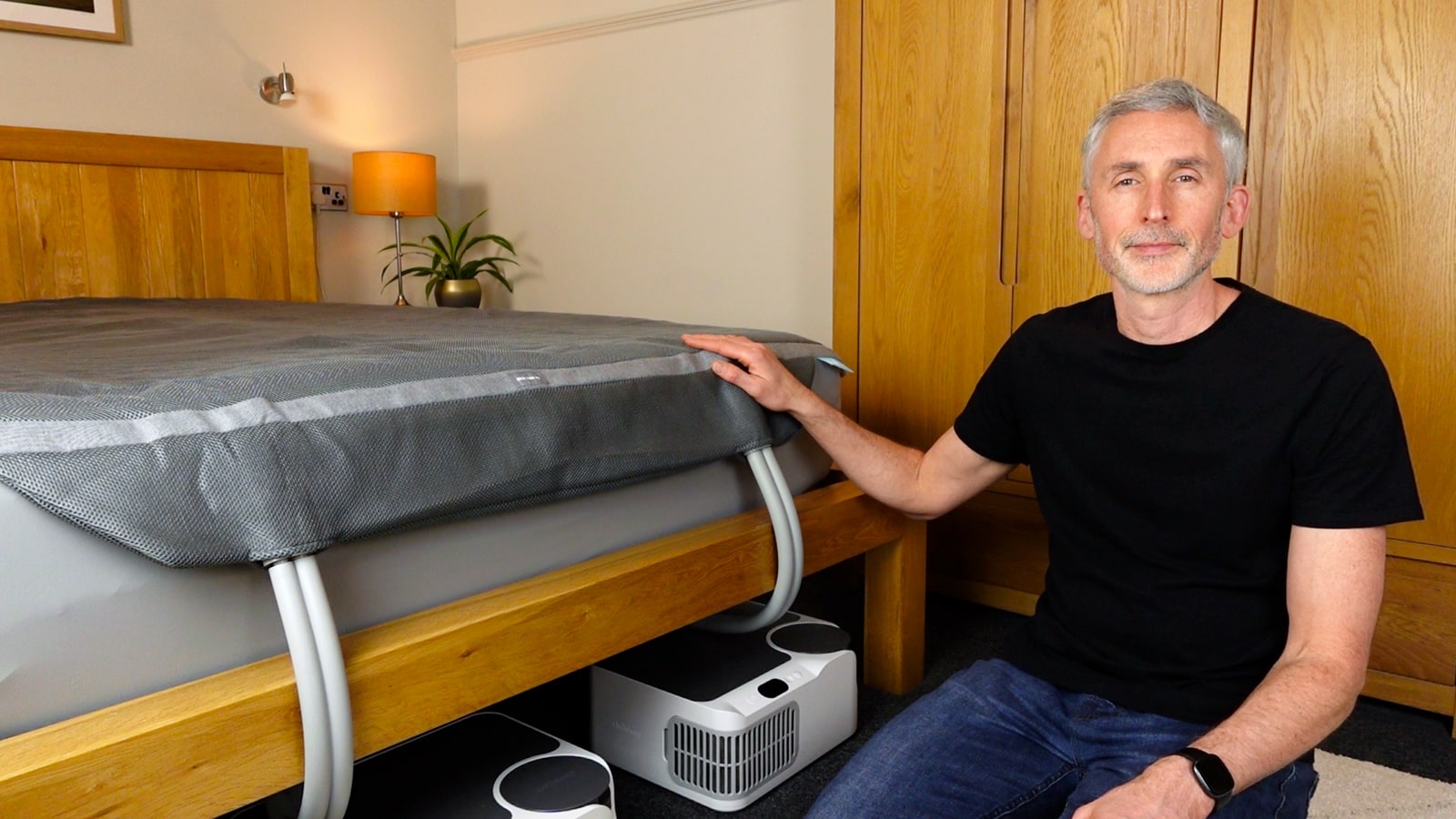
In this video/article, what I wanted to do was have a chat and an update about the way that we’ve used it, and the way that we’ve changed using it as the seasons progress during the year and into this year. I’ll also revisit a couple of the key points, such as the cons that I mentioned in the original review.
If you haven’t seen that review, I do recommend watching it first because I go into a lot of detail about the way that it works and look at the temperature range, the app, and all the different features. In this video, I’m just going to focus on a couple of key points that I’ve discovered and a couple of things that have surprised me as well.
Seasonal changes in the settings
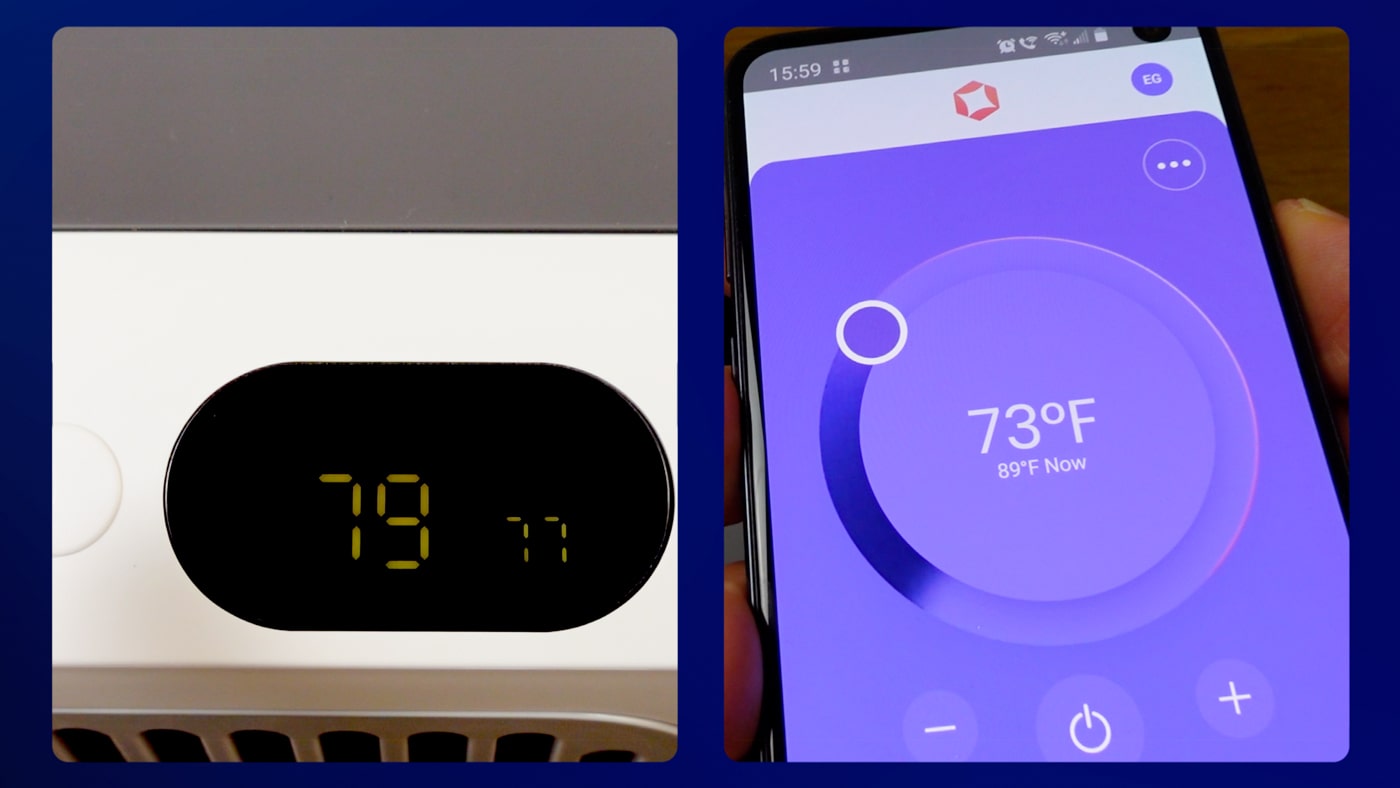
So let’s start with probably the thing that surprised me the most, which is that I haven’t even turned the app on in the last couple of months. Now, there’s nothing wrong with the app; it’s more to do with the fact that we’ve completely changed the way that we actually use the Dock Pro during the year.
In the photos below, on the left you can see the simple physical interface on the control unit that sits under the bed, and on the right is the app.
Summer
Last summer, it was really obvious that the main benefit was for the cooling, particularly on my side. I used the cooling a lot. My partner would either have some gentle heating on her side or just leave it switched off.
The thing is, with the cooling, it’s really powerful and it’s really fast. And actually, with the programmable changes throughout the night, it can take a little while to understand how it’s going to work well for you.
So I was using the app a lot just to program in different temperature changes during the night and adjust the settings. Maybe on some nights it would be really hot, other nights not so much, and so you change the settings accordingly.
Autumn
In the autumn, we were both using the app quite a lot to program our sides. I had some cooling on my side or sometimes less so. My partner was using the heating quite a lot during the autumn as it got cooler.
Winter
When it got into the winter, I discovered that I actually didn’t need the cooling at all, and just left my side often off. My partner was using her side a lot, having heating every single night.
As it got really cold, I discovered that I quite like a bit of bed warming – particularly when we’ve come in from a really cold night. If we’ve been out, come into the house and the heating’s off, it’s actually very nice to just press the button, and have the heating come on. Then as you get into bed, you can either turn it off again or use the app.
Reduced electricity cost
What we discovered is that what worked really well for us was just to turn the heating on for 20 to 30 minutes before getting into bed and then just turn it off. The benefits with that were that (A) there’s no fan sound because it’s not even on, and (B) it reduces the electricity cost.
I did a little test the other day and I ran both of them for half an hour with the heating on both. On our usual tariff of 30 pence per kilowatt hour, it only cost me 5 pence. And if you’re in the U.S., where these are sold, it would only cost you a few cents as well.
Now, I know it might sound a bit strange to only use it for half an hour when it’s such a complex system that’s designed to be used all night long with different temperature changes. But I found that that’s all that’s necessary.
When you heat it for half an hour before getting into bed, when you’ve got your winter duvet on and two people in bed, it just stays warm for a really long time – at least an hour, sometimes up to a couple of hours. By that point, hopefully you’re asleep and you don’t notice when the bed starts cooling down.
So for us, half an hour in the winter – that’s all that’s needed, which is great, because that’s just much more cost-effective.
No ‘rule’ about the way you use bed heating and cooling systems
The main point I wanted to make is that with these bed heating and cooling systems, there’s a lot of flexibility to tailor it to the season, to your own preferences, and to whoever it is that you share the bed with.
I think it’s good to know that you don’t have a set way that you can use it – you can really change it throughout the year. And if it does have physical buttons as well as the app, then you’ve just got even more flexibility.
Adding a mattress topper underneath the Chilipad
Another thing that’s changed since I did the initial review is that I’ve put a mattress topper underneath the Chilipad. I’ve actually got six layers on the bed at the moment!
We have the mattress topper on top of the mattress, then a mattress protector, then the Chilipad, then another mattress protector on top of that, then a bed sheet, and then the duvet.
That’s quite a lot of layers, and it might sound a bit extreme having so many different layers of fabric, but I found that it works really well. One of the things that I really like about the flexibility of the Chilipad is that I was able to get the mattress topper underneath it.
Below, you can see the fiber fill mattress topper I’ve put under the Chilipad to soften the bed.
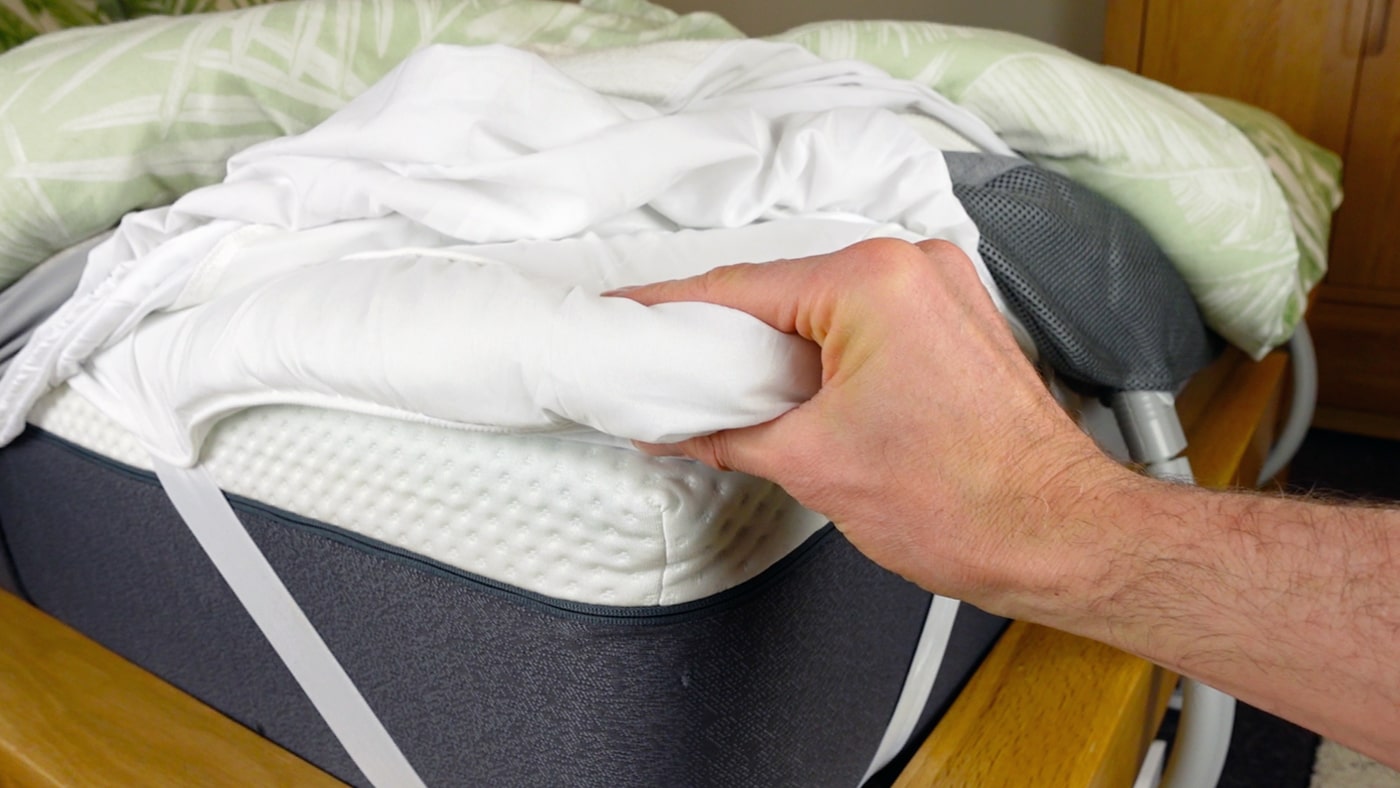
I experimented with a couple of different toppers to find something that worked. And in the end, I’ve settled for a couple of inches of fiber fill – just a normal, not even particularly expensive mattress topper. I found that that just gives a little bit of extra softness, which is what I was looking for anyway.
It’s not because this particular surface is hard; it’s more the fact that you can actually put something underneath it, so I could soften the whole bed.
Now, having two mattress protectors might be a bit of overkill, but I was kind of concerned about having all the water, so I wanted to have a mattress protector underneath it in case there was any leaking. And also one on top of it, more to give a bit of extra padding, because you can feel the roughness of this surface if all you have is a bed sheet. So just having a mattress protector and then the bed sheet, I found works really well.
No leaks or other issues so far
Another important point I wanted to make is that we’ve had no problems whatsoever with the Dock Pro. There have been no leaks, no connectivity issues, no condensation or mildew that I can tell. So on that front, I’m very happy, and fingers crossed it stays that way.
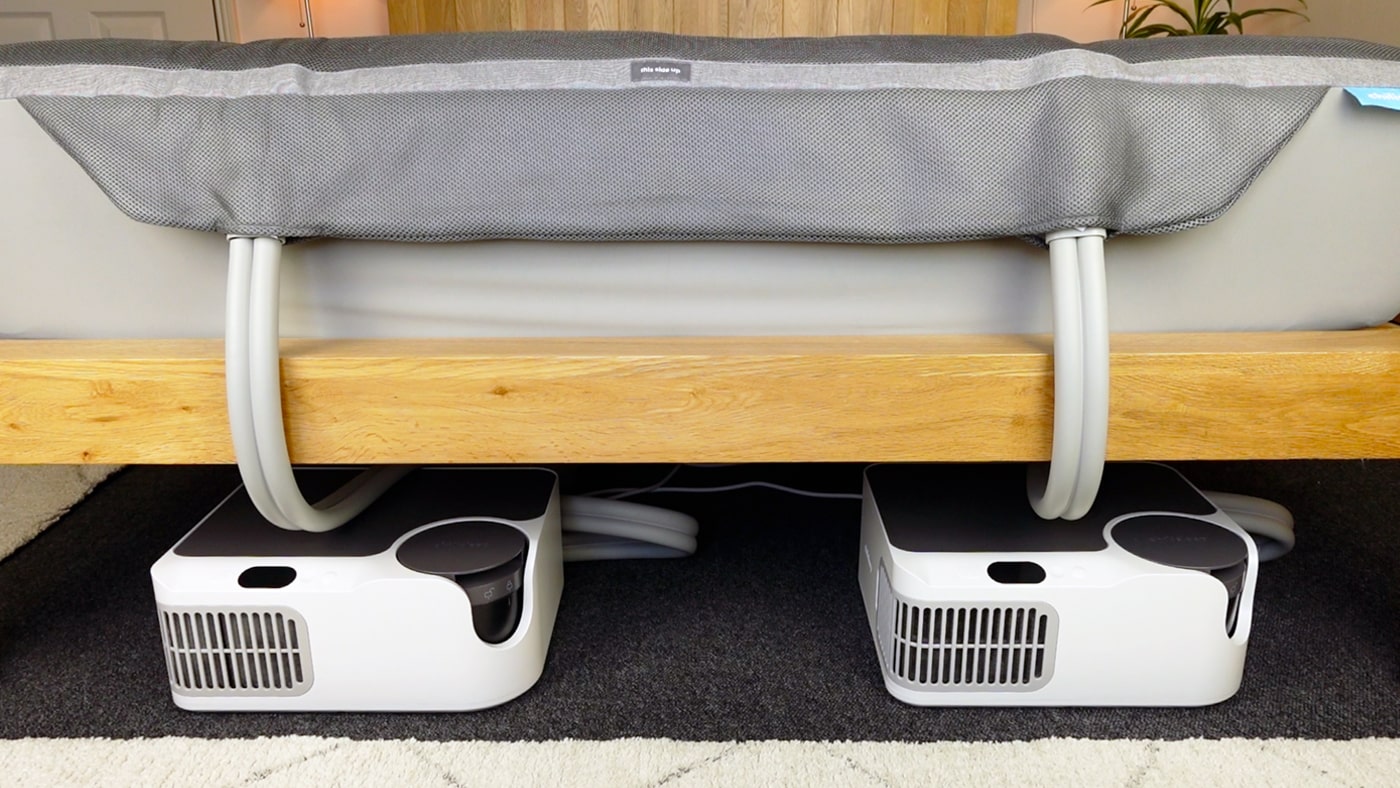
Below, this is how our Chilipad Dock Pro WE (dual zones) system looks after seven months. There’s no real difference as we haven’t had any problems. Admittedly, the base units under the bed were a bit dusty before I cleaned them for the photo!
Maintenance
Okay, let’s talk about the maintenance. For me, along with the noise, this is definitely a criticism that you need to be aware of. There’s so much maintenance required, especially compared to the Eight Sleep and the BedJet 3, which require virtually no maintenance in comparison.
Firstly, you need to take both of the control units to the sink or bathtub every month and drain them. It doesn’t take very long, and I manage to drain them and refill them again in about 10 minutes, but it is a bit of a faff that you need to do every month.
Below, I’m draining the main unit. This is relatively quick and easy, and it’s not very heavy.
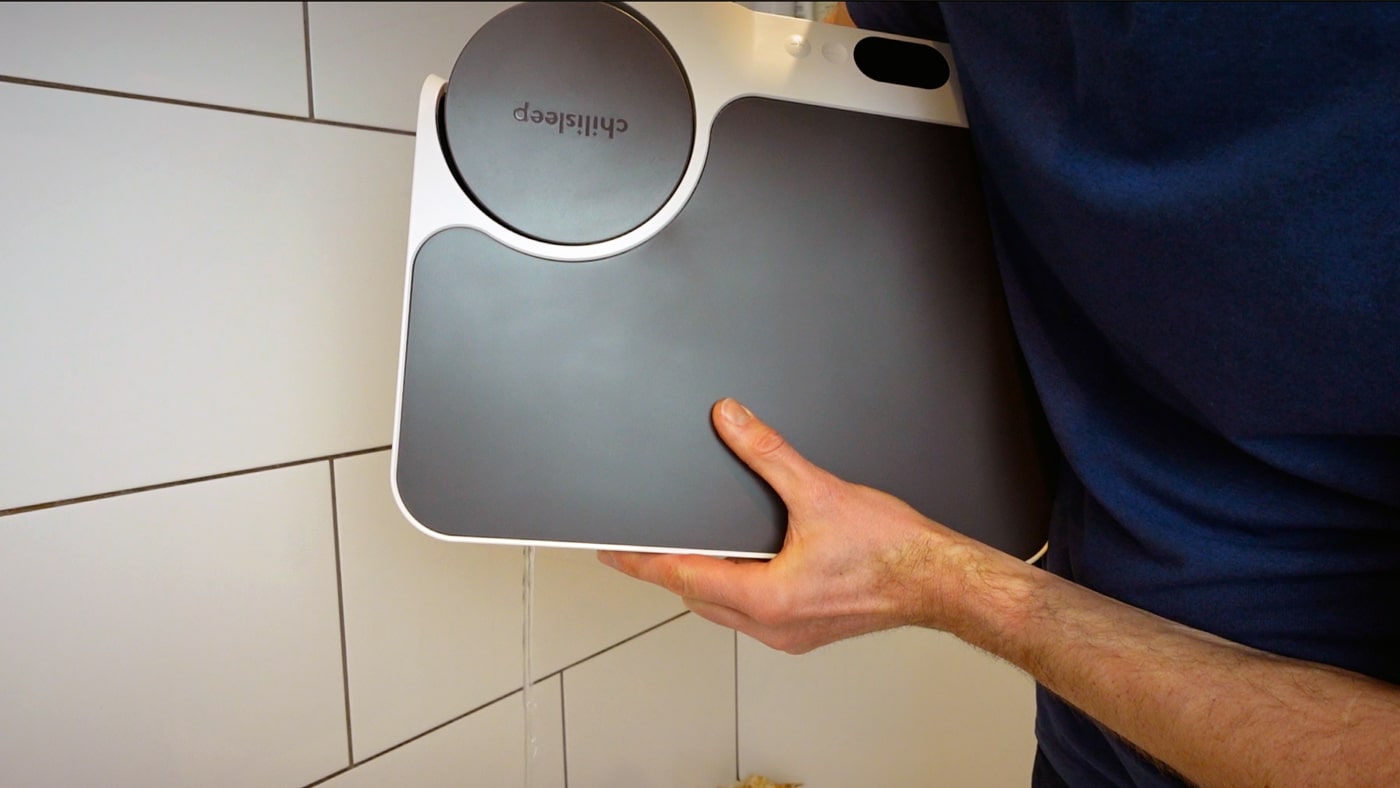
What bugs me is that you need to use this cleaning solution every time you refill them. They only sell these on the SleepMe website, and it’s going to cost you around $200 a year if you use it every single month with both units as you’re supposed to, which is quite a lot of ongoing costs I think.
But the thing that annoyed me the most is that every six months you need to completely drain the Chilipad. That just takes quite a lot more effort than the simple process of draining the control units.
I found that I had to lean over the bathtub with the whole thing over my shoulder, a bit like Santa! I wanted to drain the water into the bathtub without spilling it on the material itself or getting it all over me or the floor whilst trying to manoeuvre the material around to get more of the water out.
In the photo below, I’m doing the hardest part of the maintenance. Sleep Me advises hanging the pad on a shower rail, but I couldn’t because it meets the ceiling. That meant I had to hold it in an awkward way and keep changing the position to get all the water out. Depending on your fitness level, this could be a two person job.
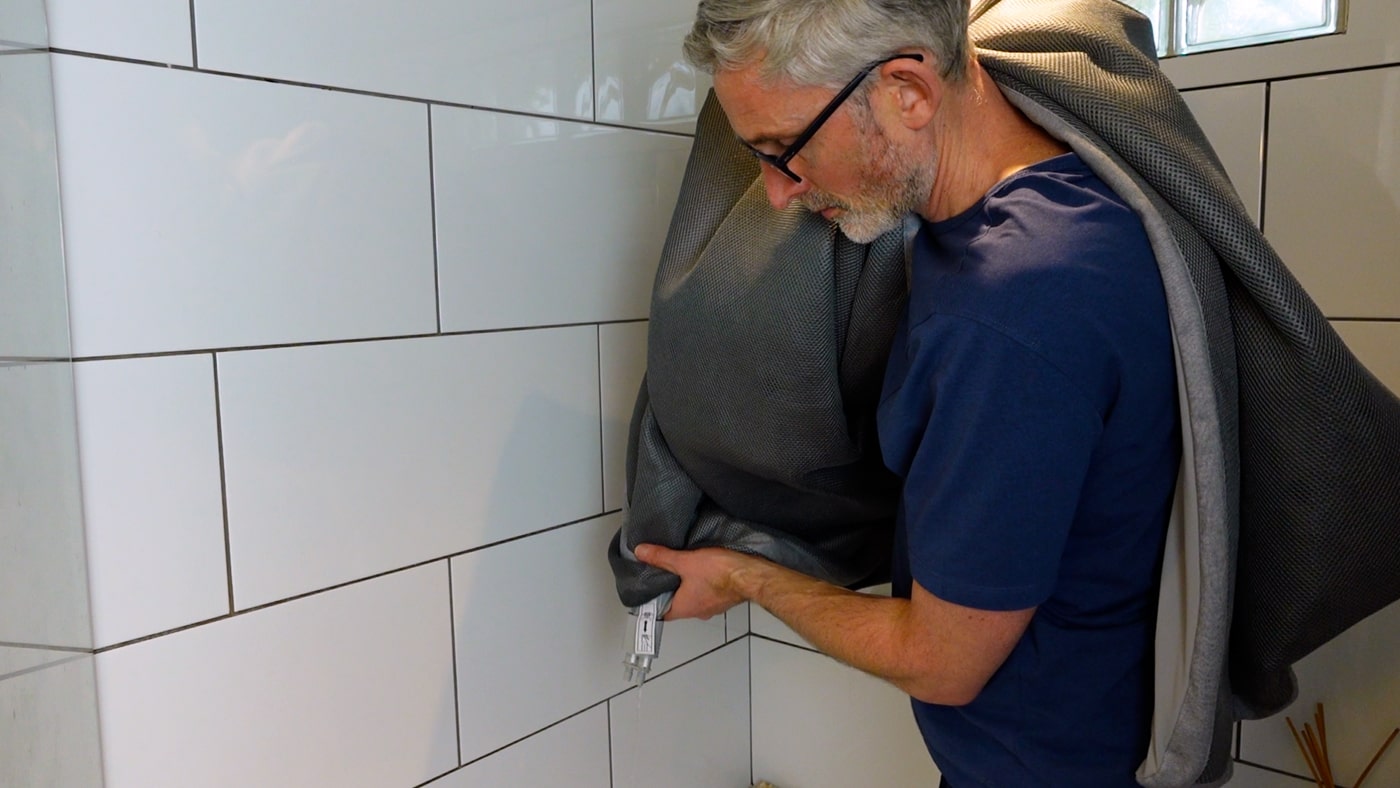
It is a bit of a process. It probably took around half an hour in total to get it off the bed and drain it all, and then put it back on again.
However, if you’re going to wash it, then it’s going to take even longer, obviously. But on the plus side, I do like the fact that you can actually machine wash the entire pad, which you can’t do with the Eight Sleep by comparison.
Then you’ve got a couple of other things that you need to remember to do, like wiping down the grills and then changing the water filters, which is also going to cost you a few dollars a year; not as much as the cleaning solution thankfully.
Cleaning the grill below. Take it off slowly as a lot of dust will fly off if you let it ping off like I did the first time!
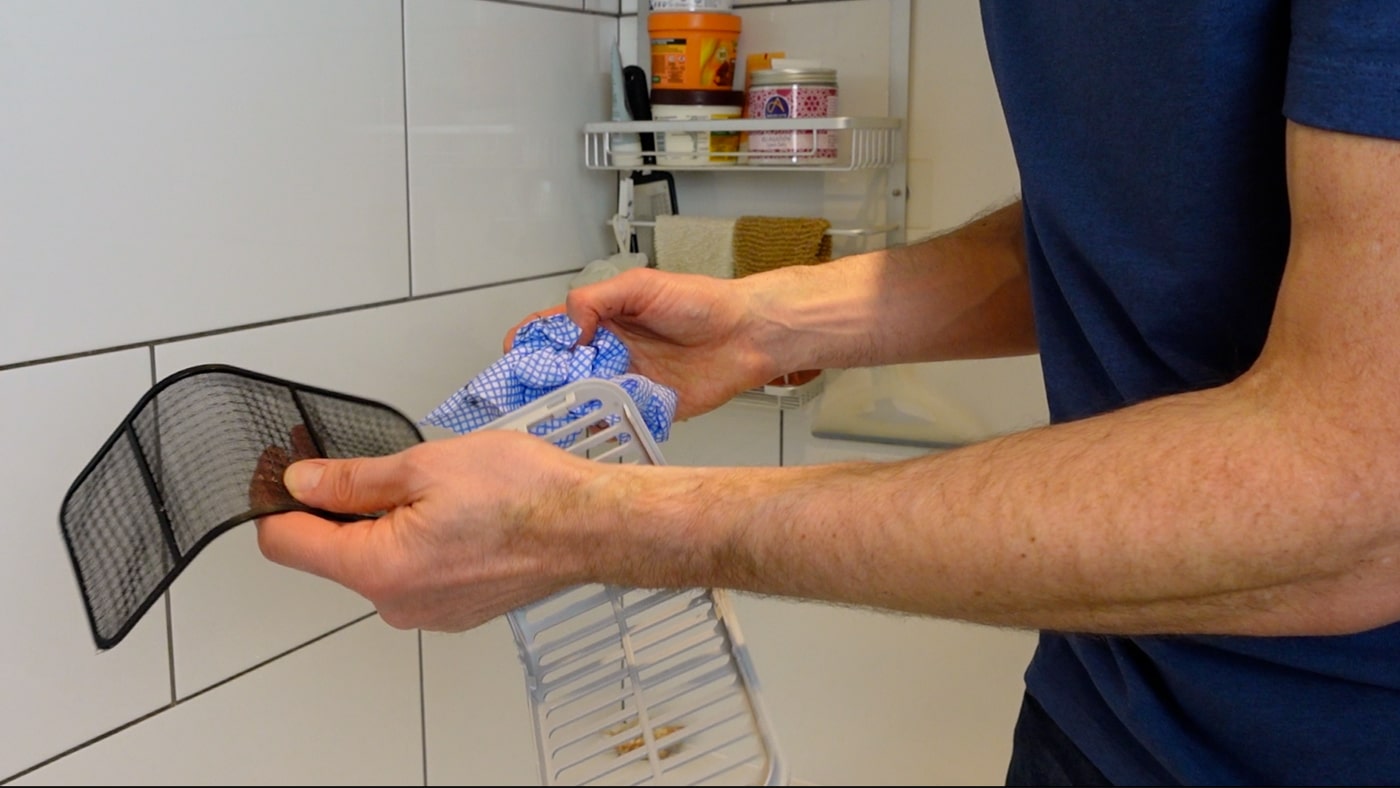
So overall, there’s quite a lot of maintenance that you need to do. So, I think it is really important to understand that if you’re not the kind of person who is hands-on with stuff like this, or you’re going to forget to do it, then you’re going to risk problems building up with the system because you’re not looking after it properly.
That means you need to be willing, able, and financially willing as well to actually go through all of that process on a regular basis.
Water reservoir refilling frequency
Let’s revisit a couple of the other criticisms I had in my initial review: the noise and the water reservoir size.
Yes, you do need to refill it more frequently than I did with the Eight Sleep, for example, but it hasn’t really become a problem. I’ve just gotten used to it.
We always keep a couple of big bottles of filtered water in the kitchen, so whenever the symbol appears on the unit or on the app (when we’ve been using the app), that it needs refilling, I just grab one of those and refill it, and it’s done very quickly. So I’ve just kind of gotten used to that.
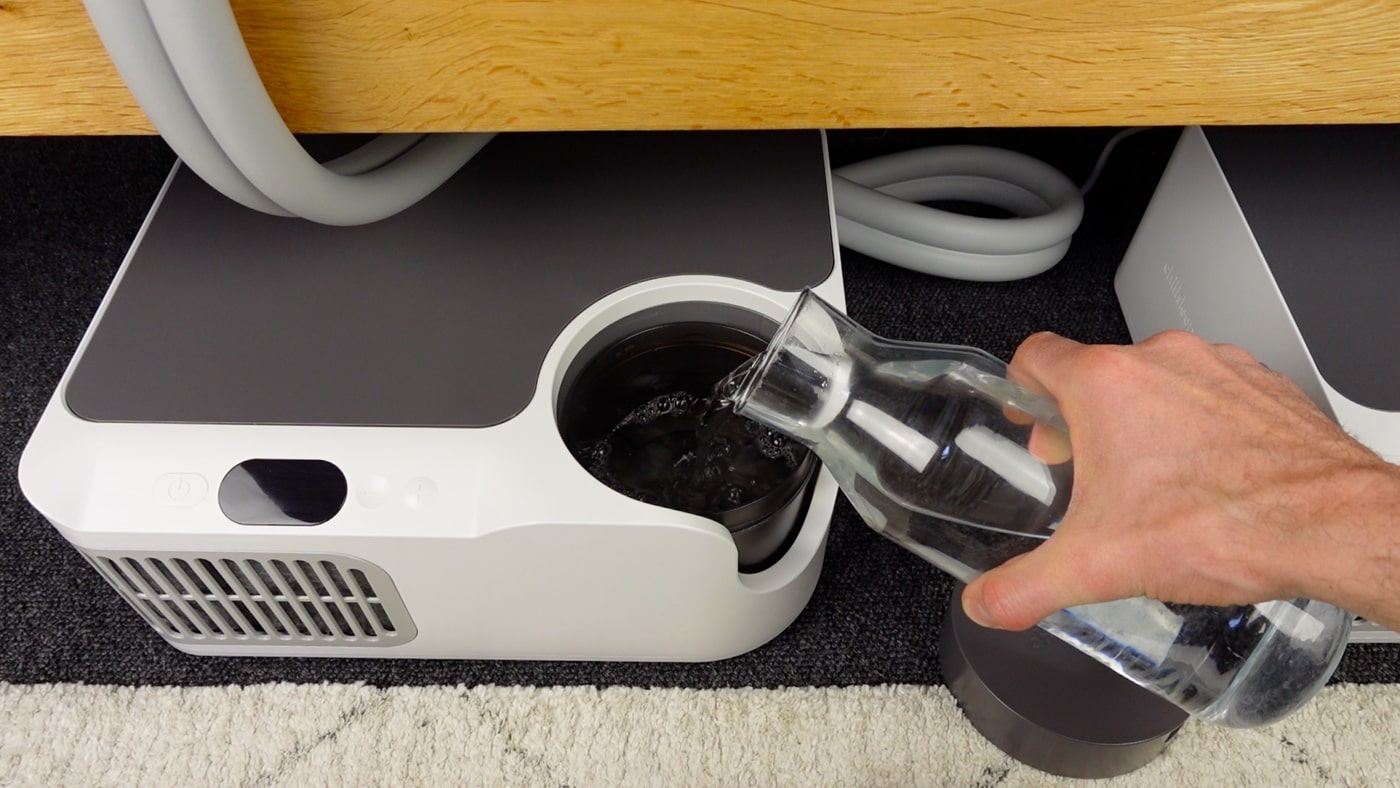
Fan noise
The noise is obviously a bigger problem, which will depend on the person. For me, as I said in the initial review, it doesn’t bother me because I use earplugs or headphones.
My partner doesn’t tend to sleep with earplugs or headphones, so she can be occasionally disturbed by the noise, especially if I’m using it all night long.
However, the one thing that I do like is the fact that the noise is very consistent. It doesn’t matter whether you’ve got it on the cooling or the heating, high setting or low setting, it’s just exactly the same noise. So, you can get used to it, I think.
But it is worth bearing in mind: if you’re the kind of person that can be disturbed by noise and you need absolute silence to sleep, you’re going to really struggle to find a bed cooling system that does that because they all make some noise.
It’s still good, despite my criticisms
I know I’ve just spent the last few minutes talking about the downsides and the things that bothered me about the Chilipad Dock Pro, but it doesn’t take away from the fact that I’ve actually really enjoyed using it. My partner has as well.
Just having that ability to control each side of the bed independently, have heating on one side, cooling on the other, is great. And it does it very effectively, very quickly, and very consistently, which is important at the end of the day I think – just having that reliability in the way that it does the cooling and the heating.
There are also some extra little details about it that I’ve really liked, such as the fact that you don’t have to pay a monthly subscription like you would with the Eight Sleep, or even with the Dock Pro if you got the sleep tracking as well.
I really like the fact that you can just have the bed heating and cooling without an ongoing subscription cost. So if you’re not a fan of subscription models, this is one to consider.
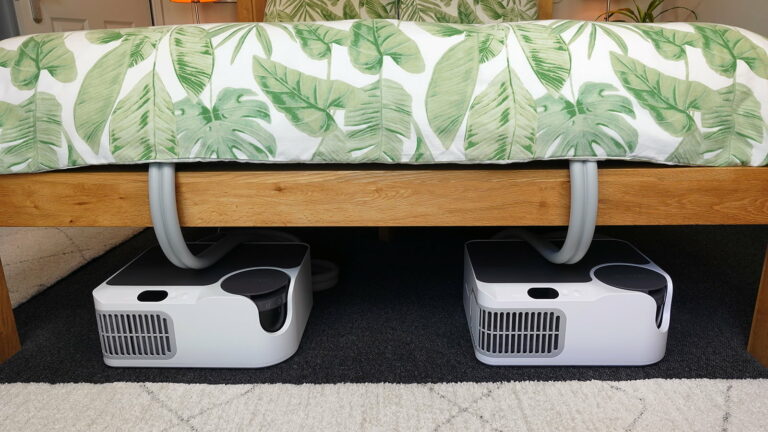
Below, you can see that with the duvet on my bed, the only visible parts are the base units and the water tubes. Depending on how much space you have under your bed, you can tuck them away out of sight and only have the tubes showing.
Understanding which downsides matter over time
I believe that it’s important to cover all the cons when you’re talking about these products because they are expensive at the end of the day. So I think it’s only fair that you present people with the potential dealbreakers.
And as time goes by, and I understand which ones are more or less important, such as in this case, filling the reservoir, and the fact that it requires more frequent filling, isn’t really such an issue.
But doing the regular maintenance is a bit more of an issue. Those are the kind of things that you learn over time.
So, if you’ve watched this video (or read this article) all the way to this point, I’d like to ask you: can you let me know in the comments below if you found it useful? Because it’s the first time I’ve done this style, where I’ve come back to revisit some of the points that I made before. It would be really good to know if people find it useful because then I’ll do more of them in the future.
And if you’ve got any questions about the Dock Pro that I didn’t answer in this video or my other one, let me know, and I’ll do my best to help. Thanks for watching this one. Sleep well.
Where to buy the Dock Pro
If you’re interested in trying the Chilipad Dock Pro, it’s sold on their official website – Sleep.me. They currently only ship within the US.
Just so you know, my link will give you an 8% discount code.
Update 1: More time
We continued using the Dock Pro for several months after I first published this article. We had no problems with it, and the cooling was fantastic in the early-mid summer of 2025 as we had some very hot nights!
Update 2: No sleep tracking add-on or subscription fees
SleepMe decided to permanently remove all subscriptions fees later in 2025. As part of that change, they stopped offering the sleep tracking add-on and decided to focus purely on the bed cooling and heating side.
Having said that, you do in theory need to buy their cleaning solution, which will cost just under $100 per year for each unit. Some people might cynically call this a stealth subscription, but SleepMe argue that it’s needed to keep the system working properly, and not too dissimilar to needing to buy ongoing products for a fish tank or car, for example.
I know some people have looked into finding their own cleaning solution, which the company doesn’t currently recommend. I don’t have any advice about that other than to do so at your own risk and to keep in mind it might void the warranty if something goes wrong.
Update 3: The new Chilipad 2.0
In July 2026, I got the new Chilipad 2.0 and have been using it for the last few weeks. I plan on doing a full video and written review when I’ve had a bit more time to use it, but I wanted to share some of my initial thoughts for anyone looking into the 1.0 and 2.0 version.
Name change
First of all, as I mentioned at the start, SleepMe decided to change the name of the Dock Pro when they released the Chilipad 2.0, which is a bit confusing and kind of annoying to be honest as I reference the Dock Pro in many videos and articles (as do many other reviewers and customers). But there’s nothing I can do about that other than have a little moan here…
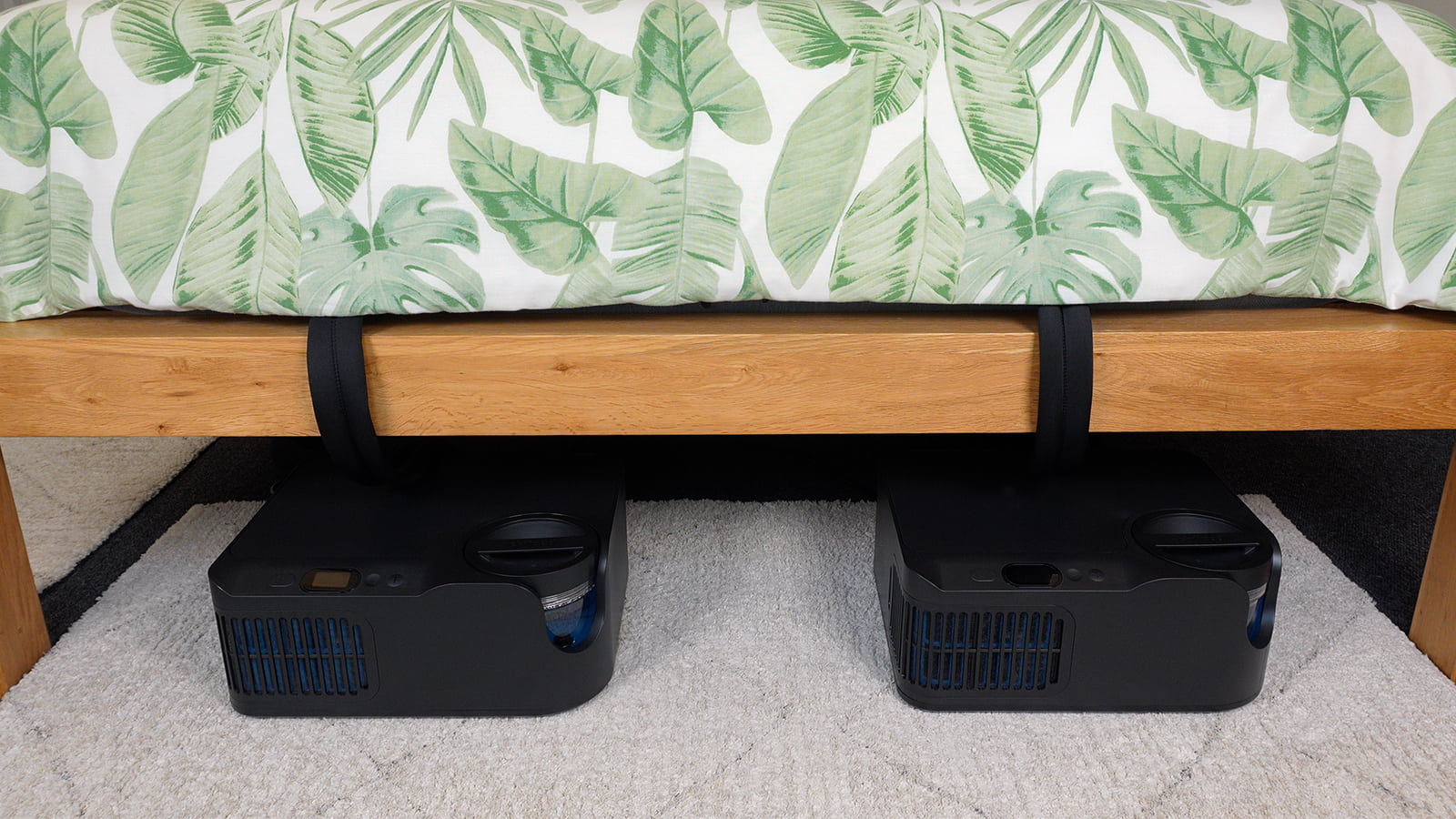
Below, you can see the Chilipad 2.0 set up in our bedroom. They are similar in shape and size to the Chilipad 1.0 / Dock Pro. But as you can see, the colour changed dramatically!
Anyway, keep in mind that the Chilipad Dock Pro is now the Chilipad 1.0 and the new model is called the Chilipad 2.0. Just to add to the confusion though, the base control unit is still called the ‘Dock’.
Here are my initial thoughts:
Things I like:
- The fan inside the Dock base unit is definitely quieter, which is great.
- The water reservoir needs to be topped up significantly less often. I’ve only had to do it once in the last few weeks, even using it to cool me every night in a hot bedroom this summer).
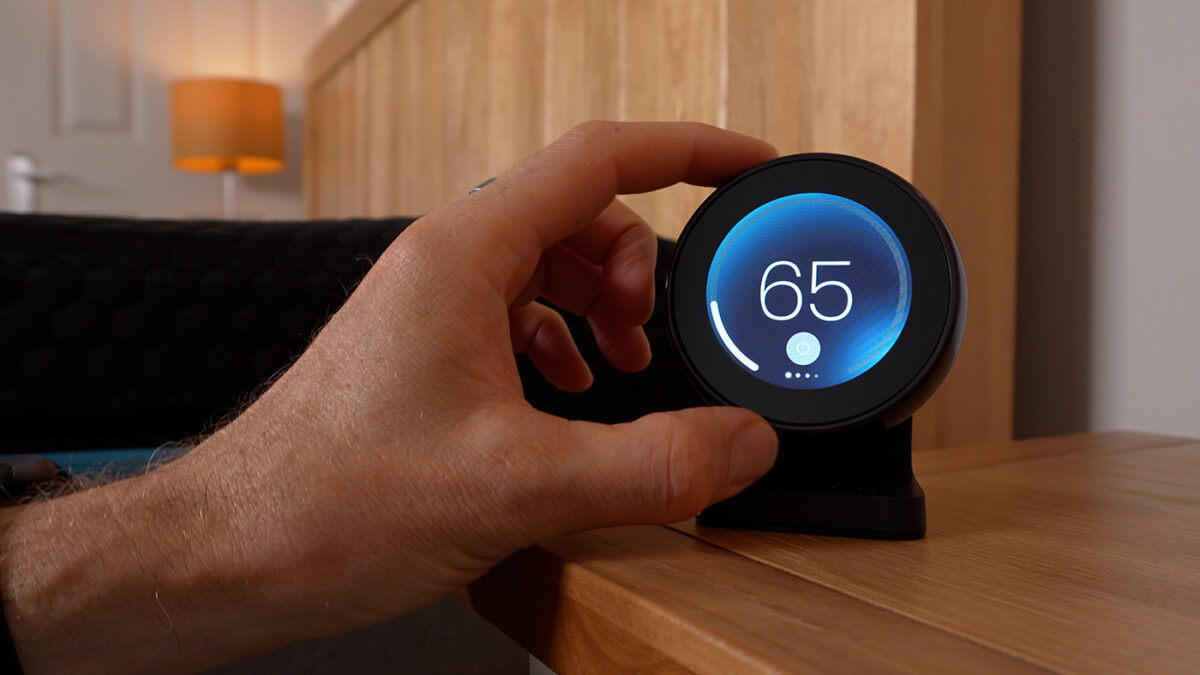
- The new remote controls for the bedside table work well, look sleek, and are really useful.
- I like that the information screen on the Dock base unit is brighter, and there are more settings you can control there now if you need to.
- The new comfort layer over the hydrolayer has a softer feel, which is a big improvement.
Below, you can see the Chilipad 2.0 remote control. In my opinion, this is an excellent upgrade, other than the need to plug it in…
Things I’m not so sure about:
- You now need 4 power outlets for dual zones and dual remotes. The remotes have a handy USB outlet to charge a device like a mobile, but it’s still a bit inconvenient. You could just use the app if the outlets issue bothers you, but now I’ve used them it would feel bad to leave them out. I would have preferred it if they were battery operated.
- It’s more complicated to install the pad as it comes in multiple sections now. This was to make cleaning easier, and make the single or dual zones modular, which is good, but it’s more time-consuming to set up.
- I don’t like the black colour of the Dock base unit. Even though they hide under my bed well with our dark grey carpet, I preferred the off-white of the Chilipad 1.0.
- The large dual-zone sizes are more expensive now – almost on par with Eight Sleep. Single zones offer a good cost reduction vs Eight Sleep though.
- The cooling and heating range is the same, but I need to select cooler temps due to the comfort layer. So I’m not sure the maximum cooling feels as cold as the Chilipad 1.0.
Overall, there’s a lot to like about the Chilipad 2.0 and there are some big tech and comfort improvements. The new remote is fantastic, other than the outlets point. But there are enough criticisms to make me think the Chilipad 1.0 is still a really good (and cheaper) choice while stocks last.
Get an 8% discount code on the Chilipad 1.0 or Chilipad 2.0 using my link below:
Thank you for the review. As an Ooler owner, I’ve wondered whether the Dock Pro would be a helpful upgrade. It sounds like the maintenance needs are similar or even increased. Your suggestion on inserting a mattress pad above the pad is also of interest.
Hi Wem
You’re welcome! I’m glad the article was interesting in some way. If your Ooler is still working and you’re happy with it, then the question is whether it would be a helpful upgrade or an unnecessary expense!
Regards
Ethan
Very helpful especially the updated information
I’m happy to hear the review and that section were useful!
Thank you! This overview was very helpful. My question is whether the pad itself, and the material of the pad, is uncomfortable to sleep on with just a bed sheet over it? I asked because I’m thinking about getting the single side of the bed version only that will go on our queen size bed that I share with my partner. And I know they will not want any mattress pad or topper or anything like that. Because we have a very comfortable mattress, it is simply just too hot for me.
Also, I know you addressed the noise of the unit. Is it comparable to a fan or white noise machine, or much louder?
Thanks again for your informational articles and videos. I have found them to be the most helpful resource of anything else I’ve found on the internet as I am beginning to research bed cooling systems.
Hi Rebecca,
You’re welcome – I’m happy to hear my site has been useful. Thanks for saying so!
I do think the pad can feel a bit rough if you only use a bedsheet, which is one reason we prefer to use a thin mattress protector as well. Would your partner not be okay with you putting a thin protector under the current bedsheet? I personally don’t think it makes much difference to the comfort in terms of cushioning, but does go a long way to softening the feel of the mattress pad.
As for the noise, it’s most comparable to a white noise machine that uses a real fan, like the Snooz devices, rather than those with recordings. But the fan sound is deeper and softer because it’s bigger than most white noise machines.
Did you catch my noise comparison sections in the various cooling videos I’ve done? That will give you the chance to compare how the systems sound alongside a desk fan.
Regards
Ethan
I am allergic to all scents so I didn’t add the cleaner to the liquid but now realise that I might get some issues. I read that you can use hydrogen peroxide instead. What are your thoughts?
Thx for your review
Hi Paula,
Sorry to hear you’re in that bind! All of these bed cooling and heating systems need some kind of cleaning. SleepMe always maintain the line that only their solution should be used. But I would reach out to them in your situation and see if they have any other suggestions. They surely can’t argue with the fact that your allergies mean the solution is not a viable option.
Regards
Ethan
I use hydrogen peroxide and it does a good job cleaning. If flow ia an issue, add some rubbing alcohol and that will help with clogs in the system. I have been a cube, ooler and now dock pro user for 6 years and love it.