

Disclosure: My website is reader supported. If you purchase a product after clicking a link, I may receive a commission, at no extra cost to you. Learn more.
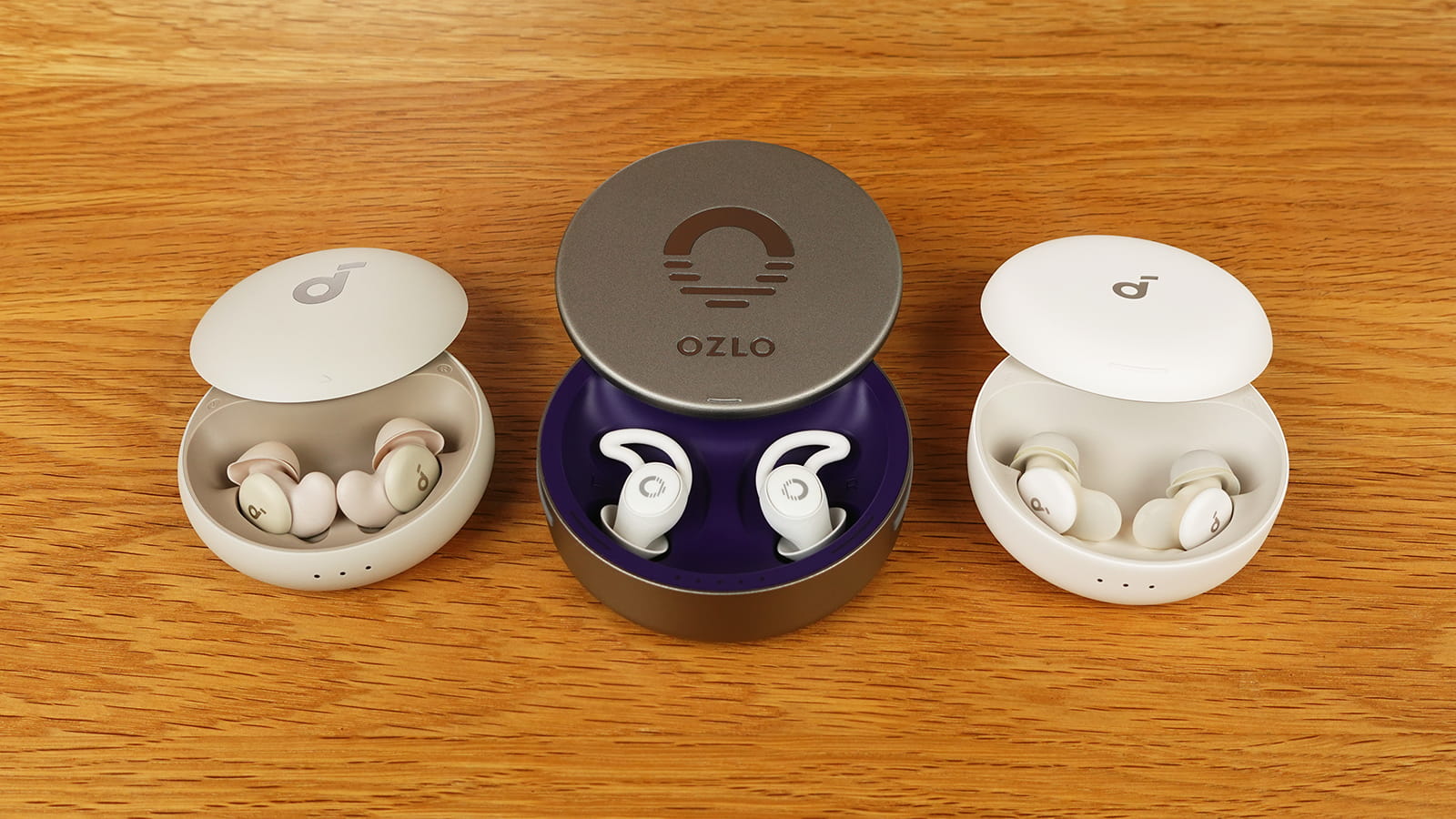
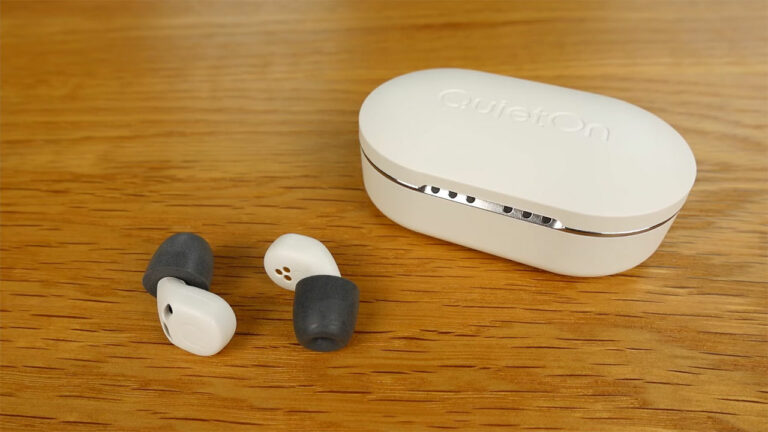
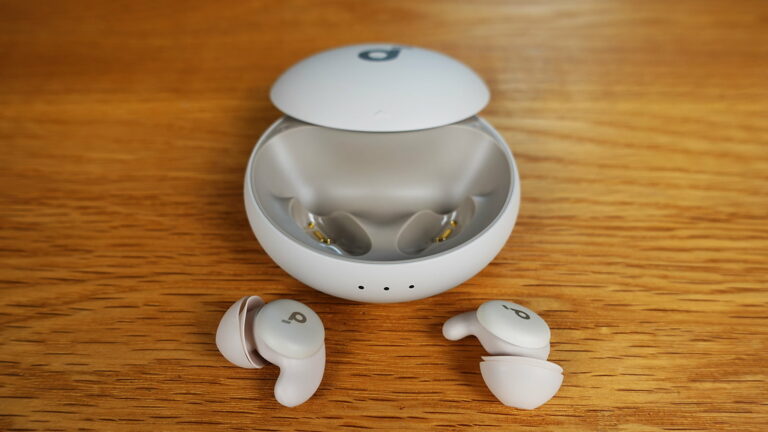
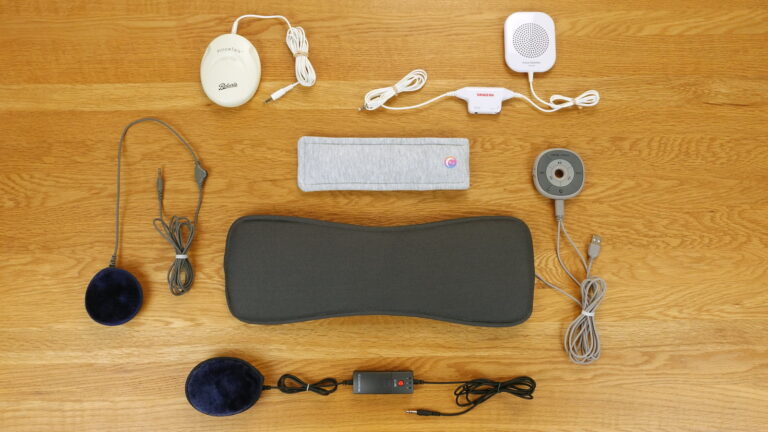
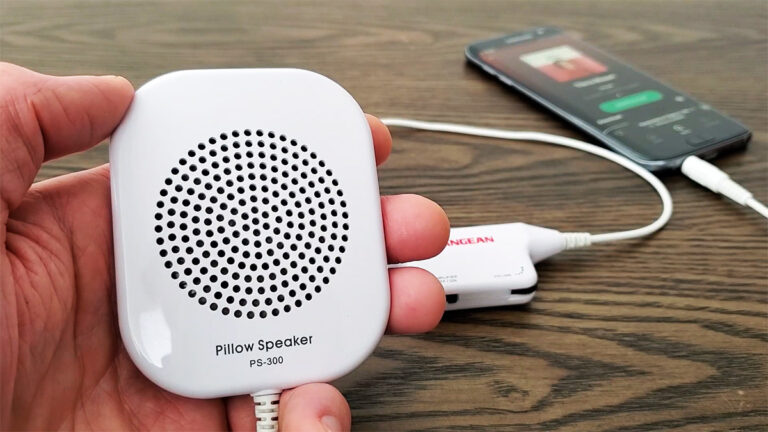
In the photo above, you can see three of the sleep headphones I’ll be discussing in this article. From left to right: Soundcore Sleep A20, Ozlo Sleepbuds, Soundcore Sleep A30.
Contents
Overviews
Detailed reviews
- Soundcore Sleep A30
- Ozlo Sleepbuds
- AcousticSheep SleepPhones
- Apple AirPods Pro 3
- Musicozy
- Soundcore Sleep A20
Introduction
As much as silence can be golden at night, sometimes listening to music, podcasts, ambient sounds, or white noise is a great way to drift off to sleep.
It’s also one of the most effective ways to deal with audio earthquakes created by your neighbour’s music or loud snoring right next to you in bed.
As you may already know, not all headphones are comfortable to wear in bed for seven to nine hours, especially if you sleep on your side or front. So it’s important to choose headphones that strike the right balance between comfort, audio quality, and noise cancellation or masking (if you need that).
In this review, I’ll be discussing the latest dedicated sleep headphones made with smaller and softer earbuds, as well as a couple of headbands. I’ve also included my favourite noise-cancelling headphones for those who really want to shut the world out at night.
Please note that all of the photos are my own and the exact headphones I tested, but the manufacturers may make changes to them in the future.
The current state of sleep headphones tech
When I published an in-depth sleep headphones comparison on my YouTube channel back in 2022 (watch it here), there were three notable absences: the Ozlo Sleepbuds, and both the Soundcore Sleep A20 and A30.
Back then, there was only a limited selection of dedicated sleep headphones, none of which had active noise cancellation. And while some were quite comfortable to wear, their passive noise isolation and noise masking weren’t as good as standard headphones.
So to block out loud noise, I had to recommend normal headphones from Apple, Bose, and Sony. But they were all too bulky for side sleepers.
In the last couple of years, however, Ozlo and Soundcore have stormed to the forefront of the sleep headphones market, and I’ll be looking at those first.
I think it’s important to make it clear that I still don’t think any of them are perfect. It’s a case of working out which ones have negative points that you can live with because they tick the most important boxes for your needs.
Finally, without wanting to sound too negative and put you off, there does seem to be a bit of an issue with the longevity of sleep headphones across the board. I’m yet to find a model that doesn’t have at least some people complaining they developed problems after a few months.
Whether it’s the natural result of using them in bed for many hours every night, or simply that none of the companies have managed to nail how robust they are is a question I don’t have the answer to. But please keep in mind that if you buy sleep headphones, there’s a risk they may not last as long as high-end standard headphones that aren’t squished by your head all night.
So with that in mind, let’s take a look at all six headphones.
Quick overview
Here are some of the key points to know about the headphones before we take a look at them in more detail.
Price ranges
- $ (Budget): under $50 / £50
- $$ (Mid-range): $50-$149 / £50-£149
- $$$ (Premium): $150+ / £150+
Soundcore Sleep A30
Key features: ANC, many noise masking sounds, local mode without Bluetooth, sleep tracking, alarms, mic for calls, touch controls on the earbuds.
Price: $$$
The Soundcore Sleep A30 are my top pick if you want the best balance of comfort, noise masking, and audio quality.
They are comfortable to wear and are the only dedicated sleep headphones with active noise cancellation as far as I’m aware. Combined with their passive noise isolation and noise masking sounds on the app, they can block out a lot of external noise.
Just keep in mind that the battery won’t last all night if you stream your own audio with the ANC active. But it will last if you either use the inbuilt sleep sounds or use their timer to switch off your audio when you fall asleep.
If you want to stream while using ANC, the A30 Special have an extended battery life (the only difference), but cost more and are only available in the US currently.
Ozlo Sleepbuds
Key features: Many noise masking sounds, multiple sounds stored on earbuds, alarms, timers, sleep tracking.
Price: $$$
The Ozlo Sleepbuds are the smallest and most comfortable of all the sleep earbuds, so they are my top pick for side sleepers who value comfort most of all.
They don’t have ANC and the passive noise isolation isn’t great either, but the noise masking sounds on the app were specifically engineered to mask snoring and other noise, and they are surprisingly effective.
The main downsides are the high price, the need to stay within range of the case if you’re streaming your own audio, and slow pairing between your audio device and earbuds.
AcousticSheep SleepPhones
Key features: Controls on the headband for volume and track, flat speakers rather than earbuds.
Price: $$
The AcousticSheep SleepPhones are the best of the audio headbands I’ve tried. They are a good alternative for side and front sleepers who find earbuds uncomfortable, no matter how small they are.
The speakers are flat, padded, and encased in the headband, so they put less pressure on the ears. The audio quality is clear enough for quiet bedtime listening, though not as good as the Ozlo or Soundcore.
The battery will easily last all night, even if that means 10 hours or longer. And the fabric band is machine washable once you remove the components.
The main downside is that they won’t mask loud snoring or other noise unless you play your audio quite loudly as the padding alone doesn’t block out much.
Apple AirPods Pro 3
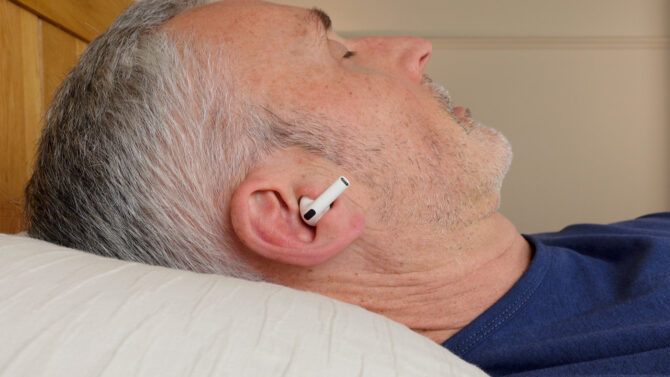
Key features: ANC, multiple touch control options, different audio modes, Apple sounds, calls.
Price: $$$
The Apple AirPods Pro 3 aren’t technically sleep headphones, but I’ve included them because their active noise cancellation is so good.
If you sleep on your back or only listen to audio for a while before going to sleep, they are comfortable enough, with excellent audio quality and responsive ANC.
I find they can mask a lot of snoring, music, television or talking in other rooms, as well as traffic. And the ANC is effective enough that I can block moderate noise even without adding music.
Obviously, side and front sleepers won’t find them comfortable for long, if at all. And really, you could use any normal headphones you like if you only lie on your back. But the superb ANC of the AirPods Pro line is what keeps me using them, especially when travelling.
Musicozy
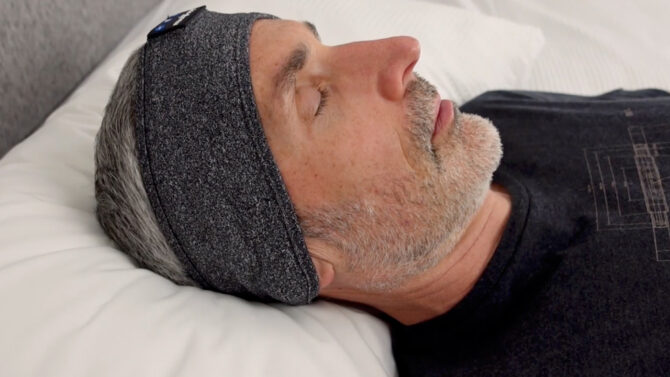
Key features: Controls on the headband for volume and track, no earbuds.
Price: $
The Musicozy are the best lower-cost alternative to the SleepPhones I’ve tried. Although their speakers are slightly thicker, they are still comfortable enough for side sleepers.
If you have a firm pillow or sensitive ears, you might feel them a bit more though. The battery life is solid and will last all night even with music playing loudly.
Like the SleepPhones, they don’t have ANC and have virtually nonexistent passive noise isolation. So these are only for quiet bedtime music or podcasts, not masking external noise or snoring.
Soundcore Sleep A20
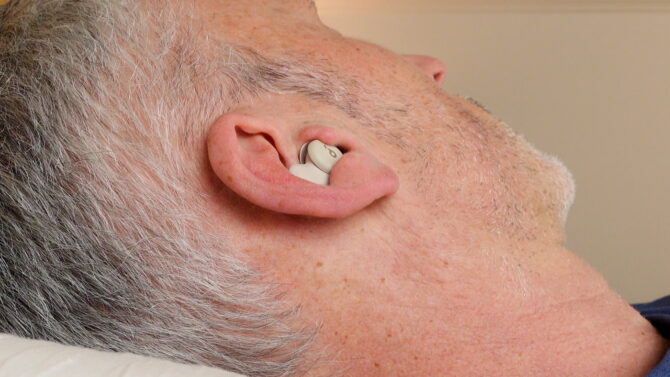
Key features: Noise masking sounds on the app, local mode without Bluetooth, sleep tracking, alarms, touch controls on the earbuds.
Price: $$
The Soundcore Sleep A20 are the predecessor to the A30, but do have two points in their favour.
The A30 are better in nearly every way, but the A20 have longer battery life. If you stream your own music over Bluetooth, you can get up to 10 hours with the A20 rather than 9 with the A30 (or less if you forget to turn off the A30’s ANC).
They also cost less, so could be a good option if you’re on a tighter budget. Just keep in mind that they are slightly larger, so side sleepers will probably find the A30 or Ozlo more comfortable.
Comparison tables
Table 1: ratings
In the table below, I’ve given the headphones a score out of 10 in some key areas: comfort in different sleep positions, audio quality, noise masking, and sound leakage.
The blue links will take you to Amazon, except for SleepPhones which goes to their website.
| Headphones | Comfort on your back | Comfort on your side | Audio quality | Noise masking | Sound leakage |
|---|---|---|---|---|---|
| Soundcore Sleep A30 | 9 | 8 | 8 | 9 | 9 |
| Ozlo Sleepbuds | 10 | 9 | 7 | 7 | 10 |
| SleepPhones | 9 | 8 | 6 | 5 | 7 |
| Apple AirPods Pro 3 | 9 | 5 | 10 | 10 | 10 |
| Musicozy | 9 | 6 | 5 | 4 | 6 |
| Soundcore Sleep A20 | 9 | 7 | 7 | 7 | 8 |
Table 2: features
In table 2, you can see which headphones have some of the key features I look out for.
| Headphones | Active noise cancellation (ANC) | Controls on headphones | Bluetooth | Noise masking or sleep sounds | Local alarms without Bluetooth |
|---|---|---|---|---|---|
| Soundcore Sleep A30 | Yes | Yes | Yes | Yes | Yes |
| Ozlo Sleepbuds | X | X | Yes | Yes | Yes |
| SleepPhones | X | Yes | Yes | X | X |
| Apple AirPods Pro 3 | Yes | Yes | Yes | Yes | X |
| Musicozy | X | Yes | Yes | X | X |
| Soundcore Sleep A20 | X | Yes | Yes | Yes | Yes |
Table 3: battery life
In table 3, you can see the manufacturer expected battery life. Please note that this very much depends on factors like the settings and volume used, and how many times you’ve charged the battery over time. In reality, ANC and audio streaming together can drain a battery quicker.
| Headphones | Potential battery life |
|---|---|
| Soundcore Sleep A30 | Earbuds: up to 9 hours with ANC, but only if audio is turned off after a short while. The A30 Special have up to 10 hours with ANC. Case: up to 45 hours. |
| Ozlo Sleepbuds | Earbuds: up to 10 hours. Case: up to 32 hours. |
| AcousticSheep SleepPhones | Up to 24 hours. |
| Apple AirPods Pro 3 | Earbuds: Up to 8 hours with ANC, or up to 10 hours in transparency mode. Case: up to 24 hours if using ANC each charge. |
| Musicozy | Up to 12 hours. |
| Soundcore Sleep A20 | Up to 14 hours in local sleep mode, or 10 hours in Bluetooth mode. Case: up to 80 hours. |
Detailed reviews
1. Soundcore Sleep A30
The best noise-cancelling dedicated sleep headphones
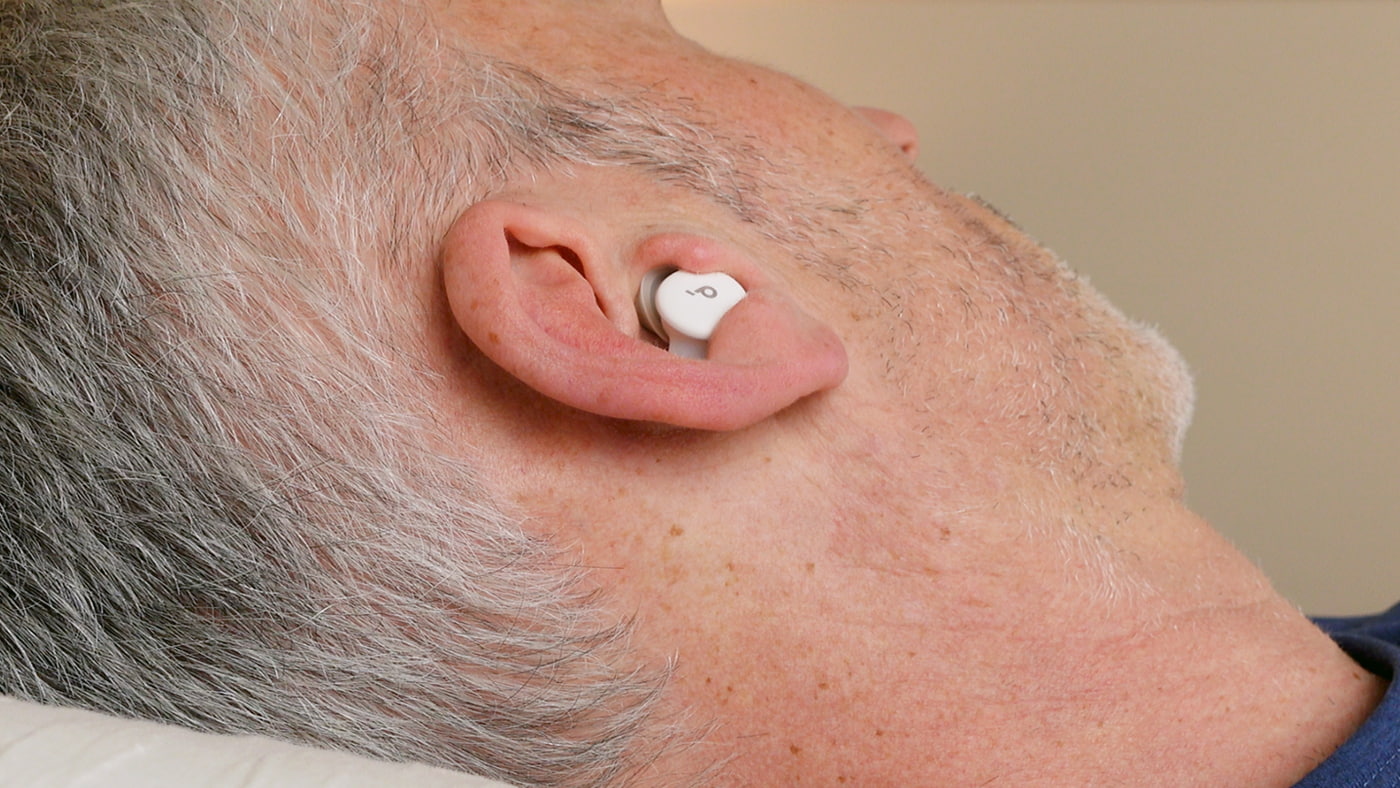
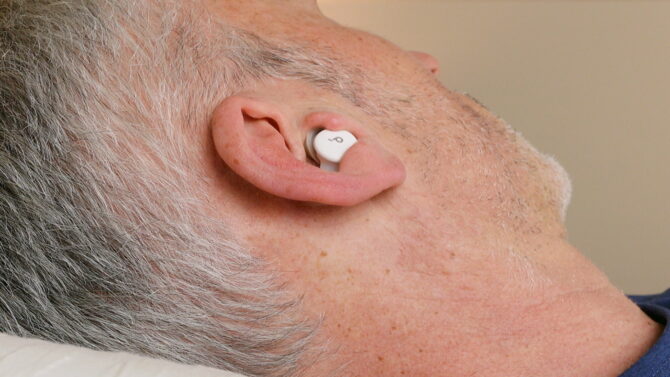
In the photo above, you can see how the A30 sit quite flush inside my ear canal, especially compared to standard headphones.
The Soundcore Sleep A30 is the third model in their line, after the A10 and A20. So Anker Soundcore is clearly determined to be a key player in the sleep headphones market. There’s actually a fourth model – the A30 Special – available in the US now, which have longer battery life.
The most important point about the A30 is that they are the first dedicated sleep headphones (as far as I’m aware) to have active noise cancellation. This is a big deal because people have been asking why there are no sleep headphones with ANC for years!
In the photo below, you can see the case and earbuds. The case holds 45 hours of extra battery life for the earbuds. The best feature is the automatic light on each charging point, which makes it easier to put the earbuds back in the case in the night.
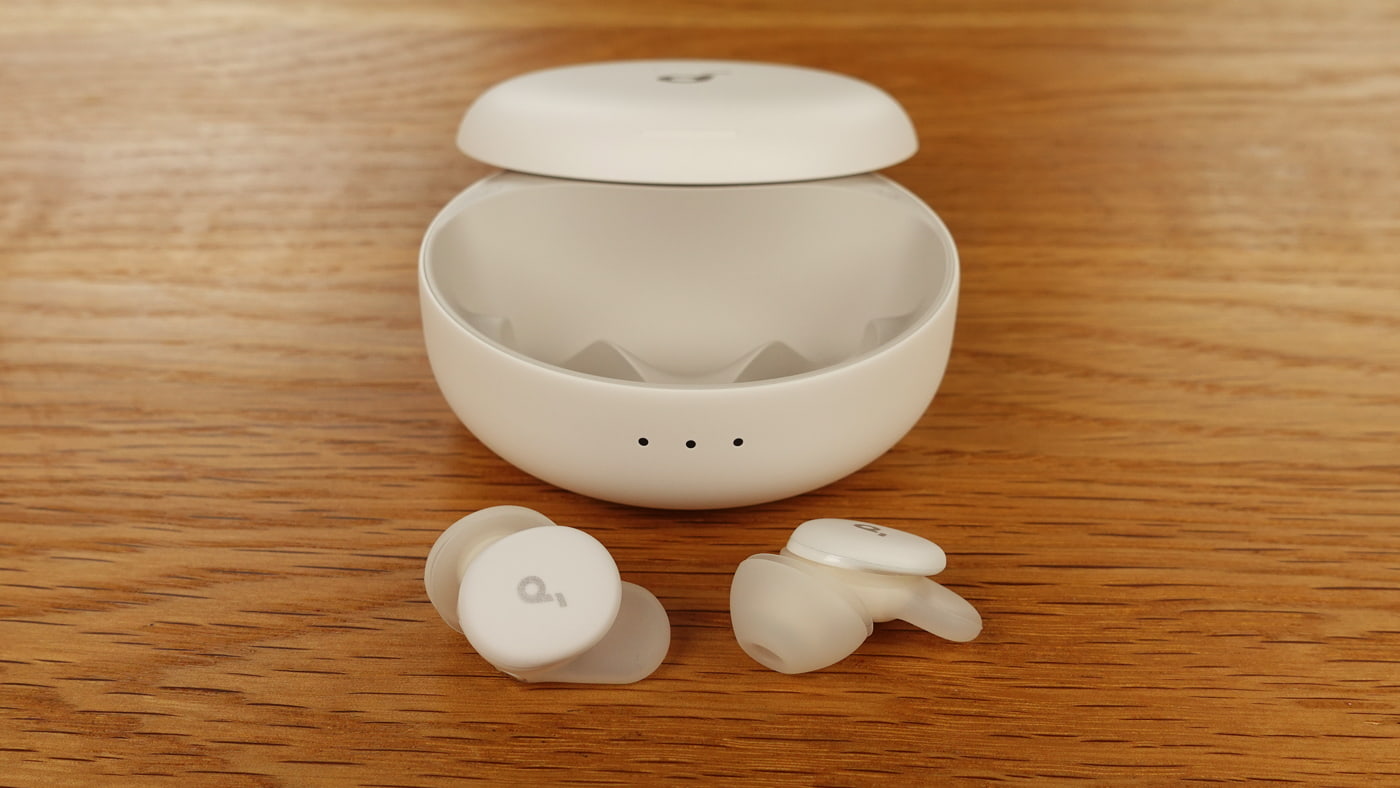
I’ve seen some reviews saying the ANC isn’t very effective, but I disagree as it’s more nuanced than that. While it’s not as good as non-sleep headphones like the Apple AirPods Pro 3 (see below), it definitely helps with relatively constant lower frequency noise.
I find it takes the edge off music coming from another room, rumbling traffic, and the hum of fans. It’s just not responsive enough for loud snoring, people shouting, or barking dogs, for example.
They also have better passive noise isolation than the Ozlo Sleepbuds and the A20, especially if you use the memory foam ear tips. There are silicone ear tips if you prefer, as well as different wing sizes to suit different ear shapes, which is great. But I prefer the memory foam tips because they block out some noise even without music playing.
In the photo below, you can see that there are three silicone wing sizes, and four tip sizes of each material, so there are plenty of combinations to find a comfortable fit.
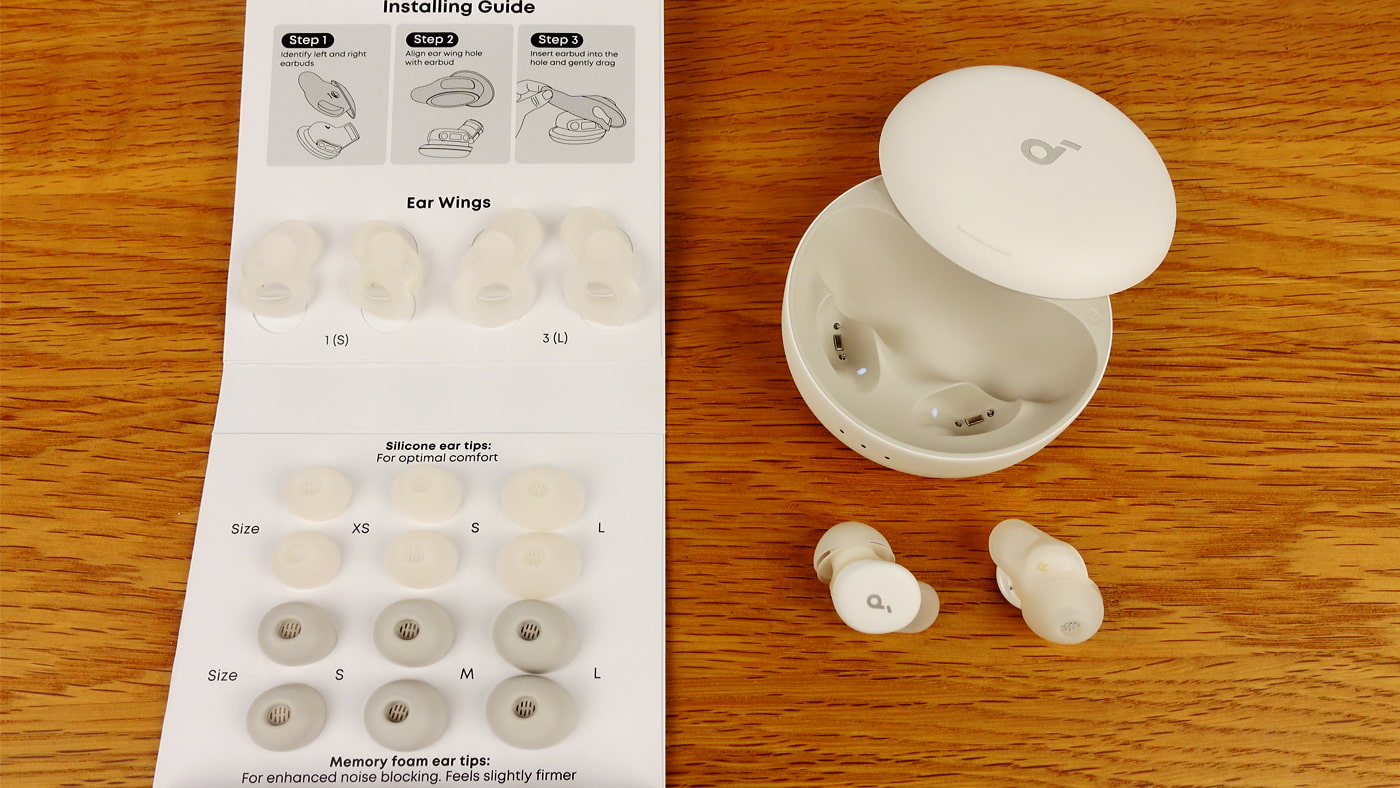
Personally, I find them comfortable enough to wear in bed all night, especially when lying on my back. They don’t irritate my ears and they never fall out.
When lying on my side or front, I do feel them though, and have to adjust my pillow and head position more frequently to find a comfortable position. They are slightly smaller than the A20, which is a welcome improvement, and clearly much smaller than standard headphones you’d use during the daytime.
However, I think side sleepers who have small ear canals, sensitive ears, or a firmer pillow might find them less comfortable. This is one of the main areas where the Ozlo might be a better choice as they are smaller and flatter, and therefore more comfortable in my experience.
As well as the active noise cancellation and decent passive noise isolation from the tips, the third element is noise masking. And for that, the app has a huge range of options.
If you want to, you can play your own music or video and the audio quality is decent for sleep headphones. It’s another area where they beat the Ozlo because they have significantly more bass and richer sound overall.
The app offers a wide selection of noise masking sounds, which you can play over Bluetooth. Some can also be downloaded onto the earbuds, and played in local mode to preserve battery life and keep a stable connection.
Many of the sounds make sense, like white noise, brown noise, river, crickets, etc. Others are a bit weird, and you can combine up to three to make some very odd soundscapes indeed.
My favourite though is the AI brainwave audio section. I spent many nights falling asleep with the starry sky, which is a form of binaural beats. I liked being able to tune the sound on the app, enable the spatial audio, and add a couple of extra noise elements. There’s a lot of scope for customisation, which is where the Soundcore app really excels.
I also like setting it to turn off after I fall asleep, and then just have silence with the active noise cancellation active. That relies on the inbuilt sleep tracking function being accurate. Comparing it to my Oura ring and Eight Sleep Pod 5, it’s actually quite good at deciding when I fall asleep.
However, one big criticism is the actual sleep tracking data and graph. I find they overestimate how much total sleep I get, and the sleep report only has deep sleep, with no REM. So personally, I completely ignore the sleep tracking side as I don’t find it useful or accurate. Still, at least it seems pretty good at deciding when to turn the music off, which is all I really need.
My main criticism is the battery life, especially if you want to play music and have ANC active all night. If I have the sleep sounds turn off when I fall asleep, I can get over eight hours with just the ANC and no audio.
But when I played music at 50% volume through my iPhone with the ANC active, the battery drained after five hours. Weirdly, the left earbud died about 20 minutes before the right. This is presumably the reason Soundcore came up with the A30 Special, even though they only have one extra hour of battery life with ANC. Still, every hour counts when you’re sleeping!
On balance, there’s a lot to like about the Soundcore Sleep A30, especially when it comes to blocking out annoying noise at night and the huge range of features on the app.
They also have the best overall audio quality of the sleep headphones in my opinion due to the increased bass compared to the Ozlo and others. Just keep in mind that side sleepers may notice the earbuds more, and the battery life can be an issue depending on how you use them.
Price
They currently cost $160 in the US, $280 in Canada, £199 in the UK, and €249 in the EU. However, there are regularly discounted prices on Amazon when I check. If you want the improved battery life of the A30 Special instead, they will cost more.
2. Ozlo Sleepbuds
The most comfortable sleep earbuds
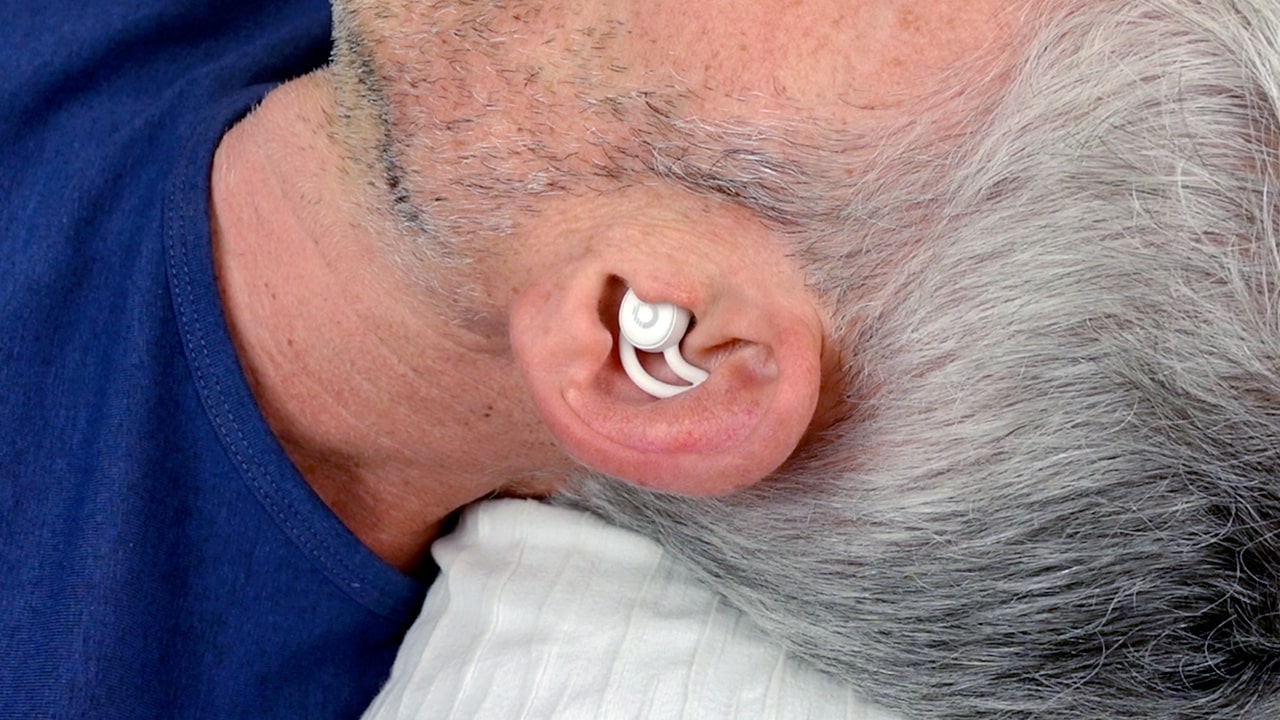
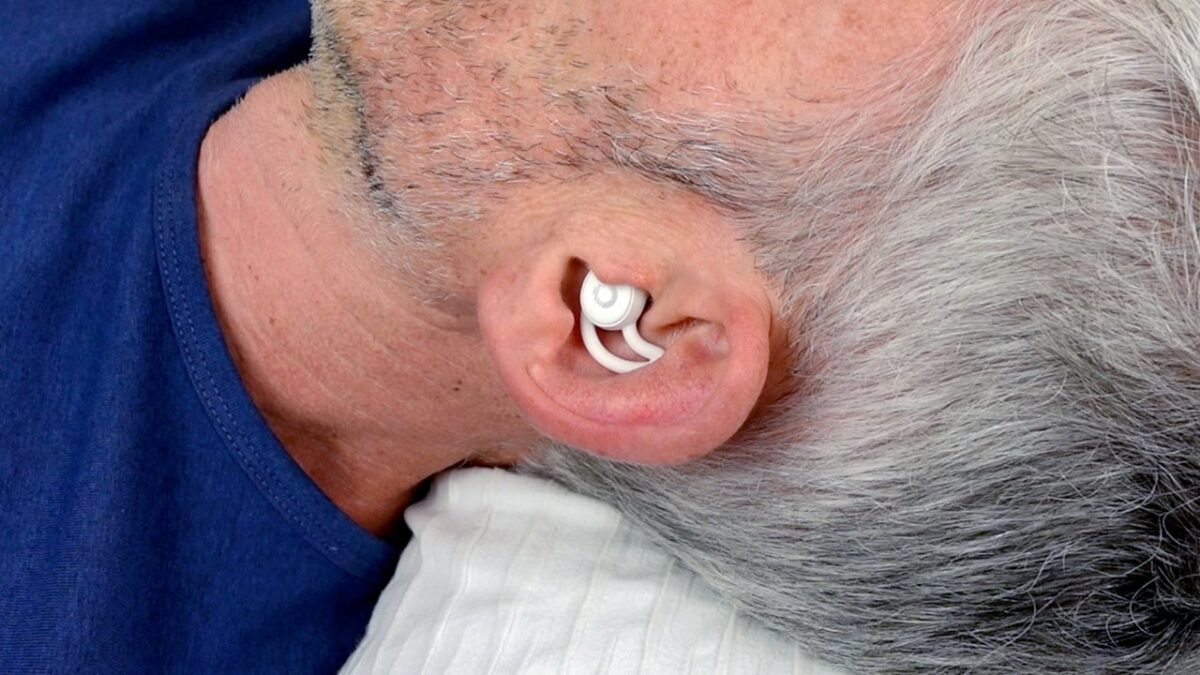
In the photo above, you can see how small the Ozlo Sleepbuds are. They are very comfortable to wear, and I don’t feel them as much as the Soundcore Sleep A20 or A30 when lying on my side.
The Ozlo Sleepbuds are great in some ways, but frustrating in others. So I feel it’s especially important to understand their strengths and weaknesses.
The best point about them by far is the small size and flat profile of the earbuds, which makes them a better choice for side and front sleepers than any of the other earbuds.
When I lie on my side, I don’t end up adjusting the position of my head as often as I do with the A20 or A30. I still know there’s something in my ears, but with a soft pillow, I can comfortably wear them throughout the night.
Now, if you have very small ear canals or sensitive ears, you’re probably going to feel them more than I do. But it’s hard to predict where the threshold is between them nestling comfortably inside an ear canal or still feeling a bit too large.
At the end of the day, there’s a solid body inside the earbud, even if the wing and tip are made of very soft and flexible silicone. So you still need to be able to tolerate having an object inside your ear.
In the photo below, you can see the case and the three extra tip sizes. Notice how each size has a combined wing and tip, whereas the A20 and A30 have separate wings and tips.
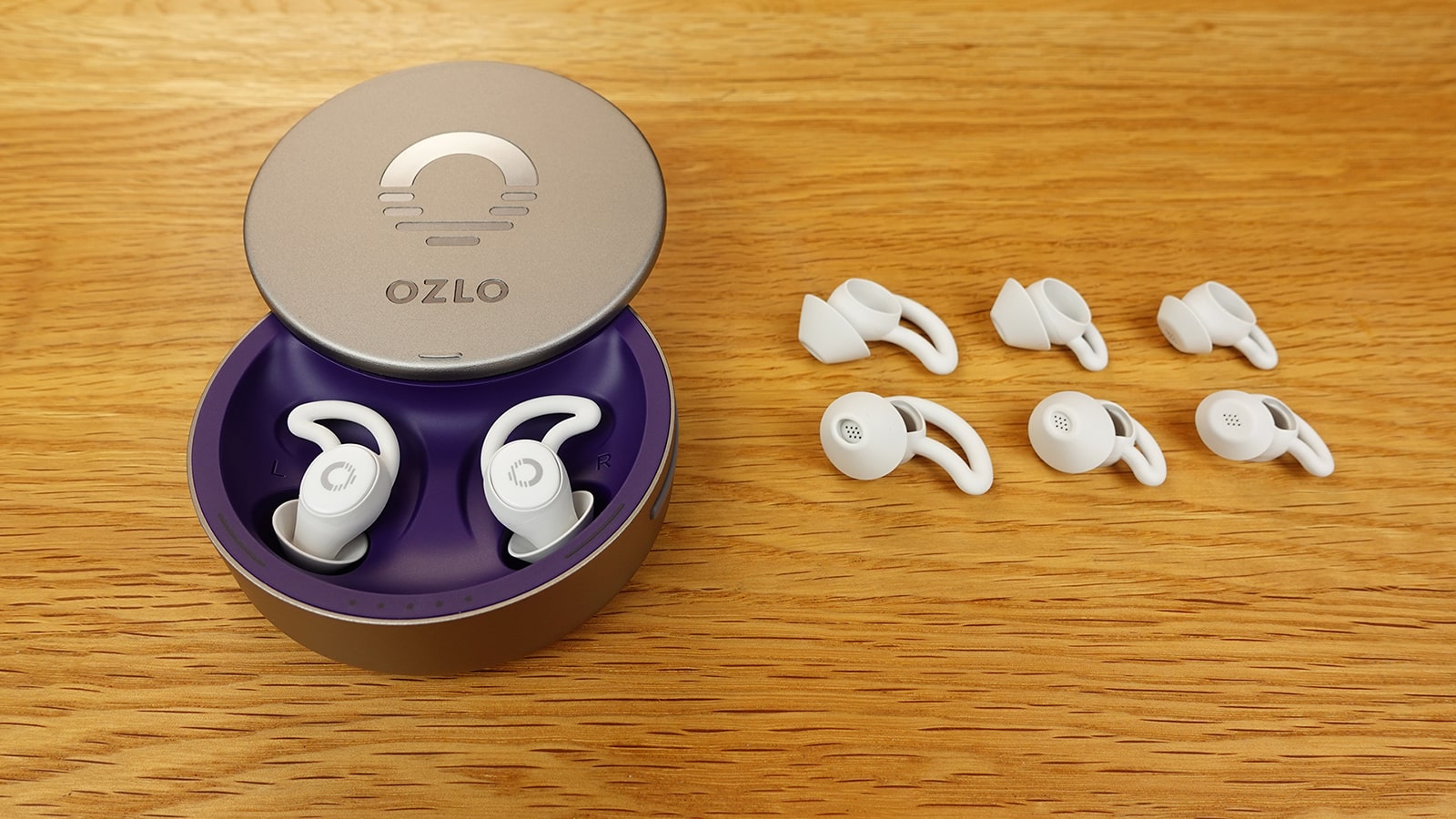
One of the most important points that separates the Soundcore Sleep A30 and Ozlo is that the Ozlo don’t have active noise cancellation. So they rely on passive noise isolation and audio to mask annoying noise.
Unfortunately, the passive noise isolation of the earbuds alone without any audio isn’t very good. I find they block very little noise, and I can still hear the fan sound made by my bed cooling system, which isn’t even particularly loud.
That means it’s down to the audio if you need to block out noise. You can stream your own audio if you want to, which is great. The Ozlo were created by former Bose engineers, and they evolved from the Bose Sleepbuds II. Those didn’t let you play your own music though, so this was a key change.
The app also has a selection of 35 noise masking sounds, up from 10 when I first reviewed them a year ago. There are some fantastic sounds, which have been well produced and sound crisp on the earbuds. There are white, pink, and brown noise options, as well as lots of nature themed tracks such as babbling brook and tumbling waters.
In the photo below, you can see some of the sleep sounds. You can upload one at a time to the earbuds to listen in local mode, which improves the connectivity if you move away from the case.
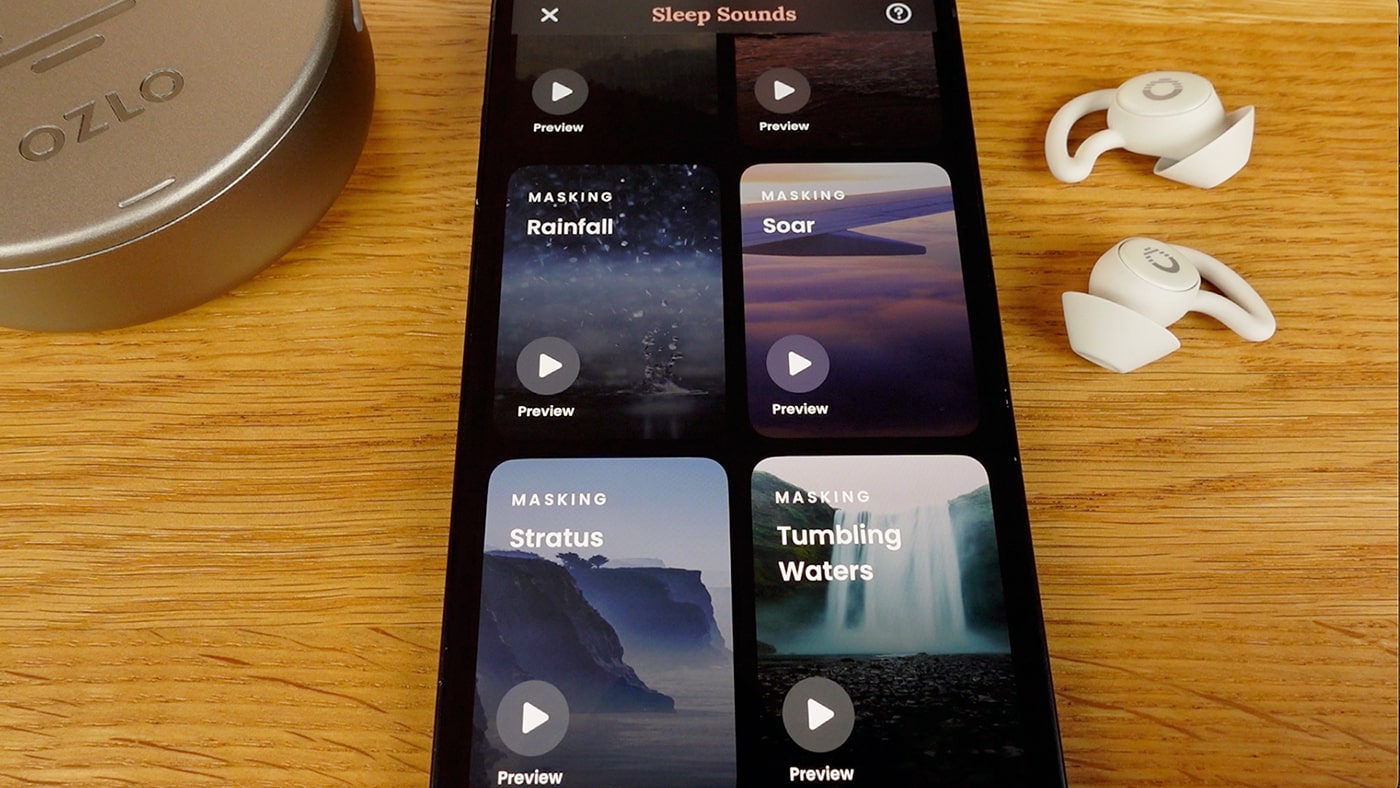
When I tested them with different noise sources, I could block out a lot of snoring, as well as music from another room. Even though they don’t have a lot of bass, they have somehow created sounds which do a very good job of masking external noise.
Like the Soundcore, they also have sleep tracking built in. Again, they are quite good at telling when I fell asleep, but tend to overestimate how much sleep I got, so I ignore the sleep tracking reports. The case has sensors to measure the ambient noise, temperature, light, and pressure during the night. This may interest some people, but I haven’t found much use for that information.
The app has some other useful features, such as alarm tones you can store on the earbuds, and the option to switch from your streaming audio to a sleep sound when you fall asleep or after a time of your choice.
My main criticisms are around the Bluetooth connectivity and the battery life, both of which can be annoying.
The main point to understand is that your device connects to the case via Bluetooth, and then the case connects to the Sleepbuds via Bluetooth Low Energy. They did that to enable a smaller battery and therefore smaller earbuds.
However, it means they need to be within range of both your device and the case if you’re streaming audio. If your bathroom is far from your bedroom, you need to carry both objects with you. It’s not a problem when listening to the sleep sounds on local mode, but it is an irritation when streaming.
Another gripe is that the earbuds need to be in the case to connect. When they disconnect, they sometimes reconnect in my ears, but sometimes need to be put back in the case, which is frustratingly slow.
As for the battery, the earbuds will easily last all night when listening to the sleep sounds in my experience, and around eight hours when streaming. But if you want the sleep tracking, the case needs to be plugged in all night. And when you’re not using them, the battery of the case and earbuds drains faster than I would expect from headphones. So you do need to remember to charge them daily.
One final downside is that there are no controls on the earbuds, and you have to adjust the audio volume in the app, not with your own device. By comparison, the Soundcore Sleep A20 and A30 have various tap controls for each earbud, which is much more convenient.
Overall, the Ozlo could be a good choice if comfort is your priority and you can tolerate the connectivity quirks and need to charge the case and earbuds regularly. They may not have the ANC and wide range of app options as the Soundcore, but they win where comfort is concerned and the noise masking sounds work surprisingly well.
Price
The Ozlo have a similar price to many high-end consumer headphones, though they have regular sales which bring the price down.
They currently cost $274 in the US, £299 in the UK, $399 in Canada, and €283 in the EU.
Check out my full Ozlo Sleepbuds review and video to find out more.
3. AcousticSheep SleepPhones
The best audio headband – a good alternative if earbuds are uncomfortable
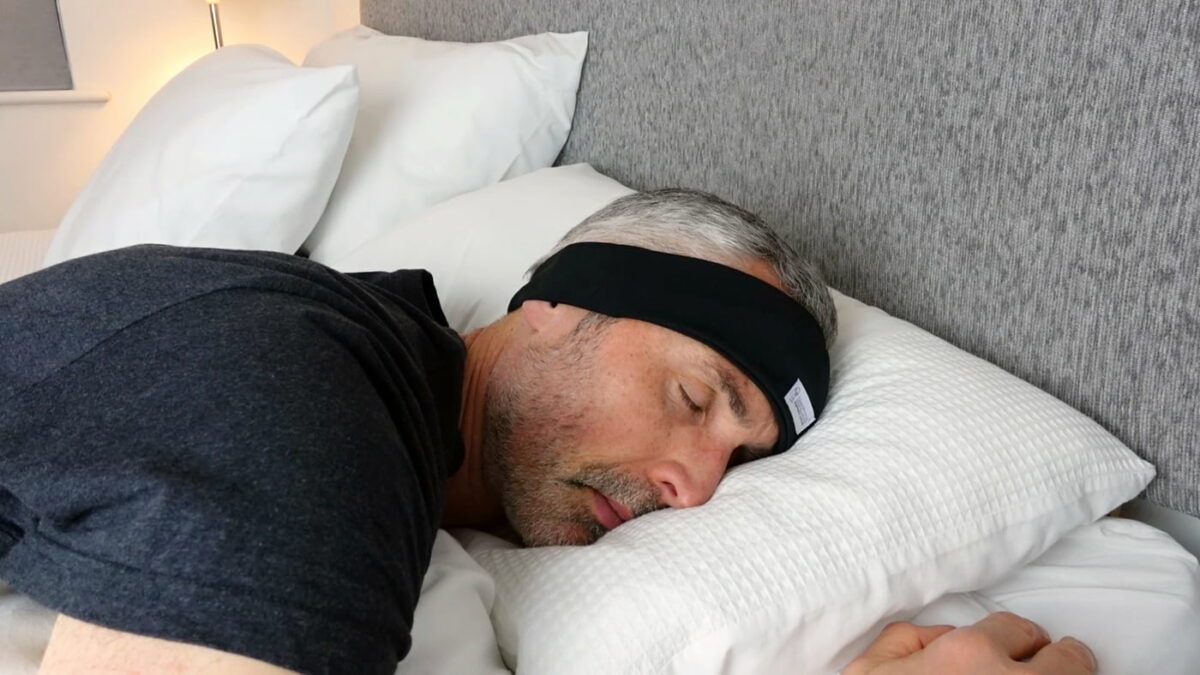
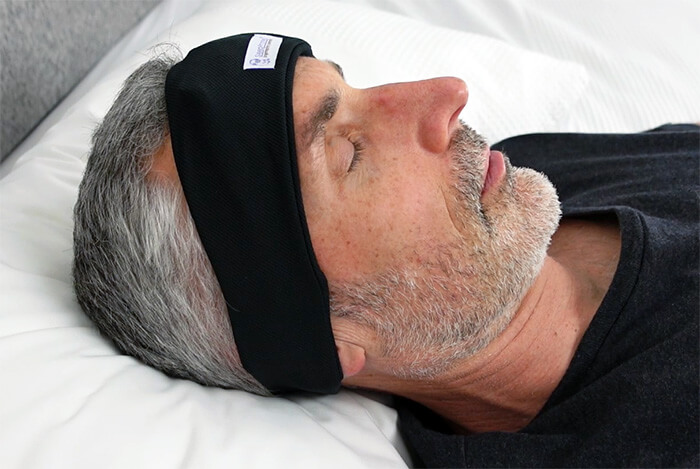
I took the photo above a few years ago, but to my knowledge, they haven’t changed the design of the SleepPhones since then.
If you absolutely can’t sleep with earbuds in your ears, no matter how small and ergonomically designed for sleep they are, one of the best alternatives is an audio headband.
I reviewed the AcousticSheep SleepPhones back in 2020, so they’ve been around for a while. They haven’t released any new models recently, but their Bluetooth headband is still a good choice for those with sensitive ears.
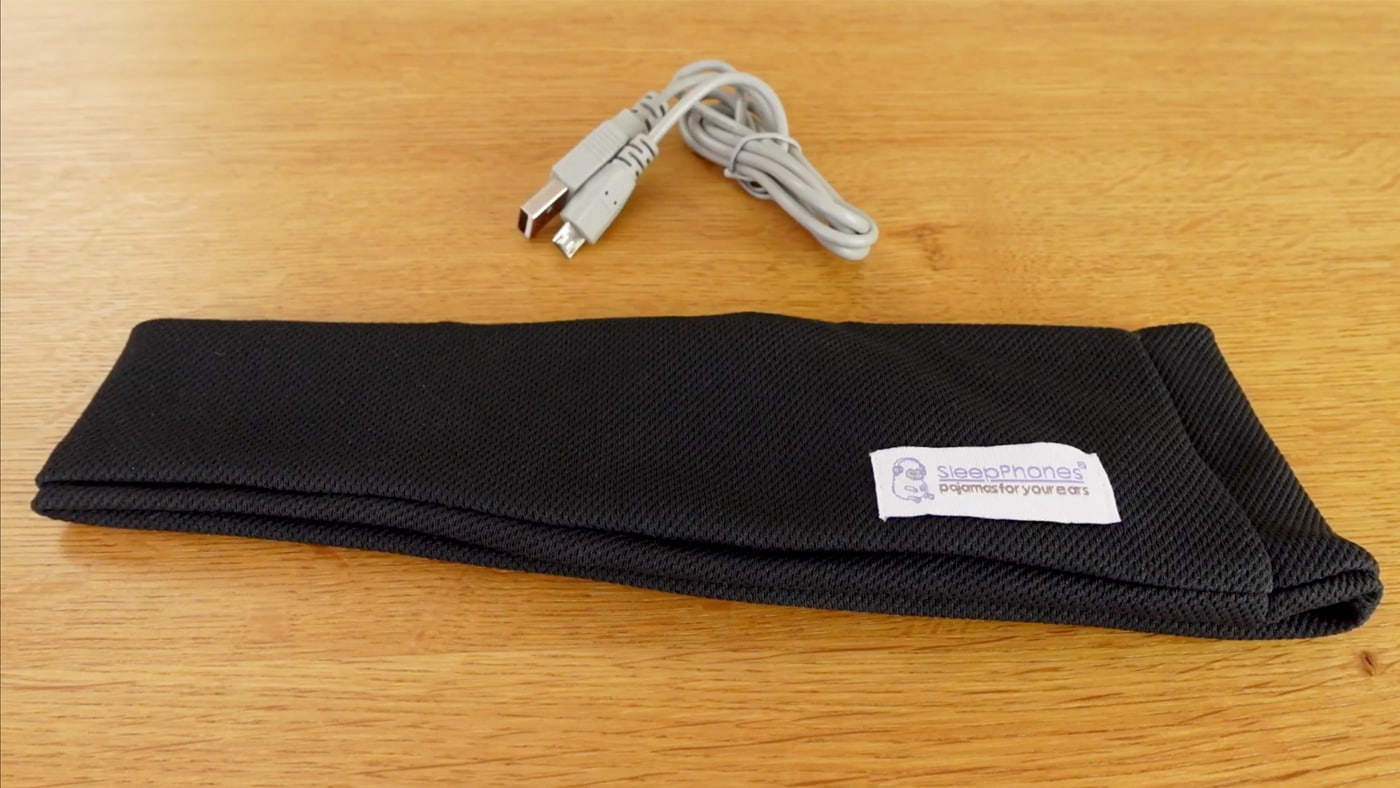
The SleepPhones were designed specifically to be used in bed and are particularly good for side and front sleepers. There’s actually a growing number of this headband style of headphones, but the SleepPhones are my favourites for three key reasons.
Firstly, they have the flattest speakers and the most comfortable padding. Secondly, the speaker quality is better than the others I’ve tried.
And thirdly, the noise leakage isn’t too bad compared to most other headbands, which typically have much thinner padding. So anyone sharing your bed shouldn’t hear much unless you turn the volume right up.
They come with a good length micro-USB charging cable, but no carry case. They take four hours to charge and last up to 24 hours. It’s a bit fiddly to get to the control module to plug in the charging cable, but they do have a more expensive version with an easier induction charging method.
The control module can be used to play and pause music, and change the volume and track. You do need to feel through the fabric to find the tiny buttons though, which takes some getting used to.
In the photo below, I’ve removed the speakers and control unit from the headband so I can wash it. The control unit sits over your forehead, while the speakers are flat and padded.
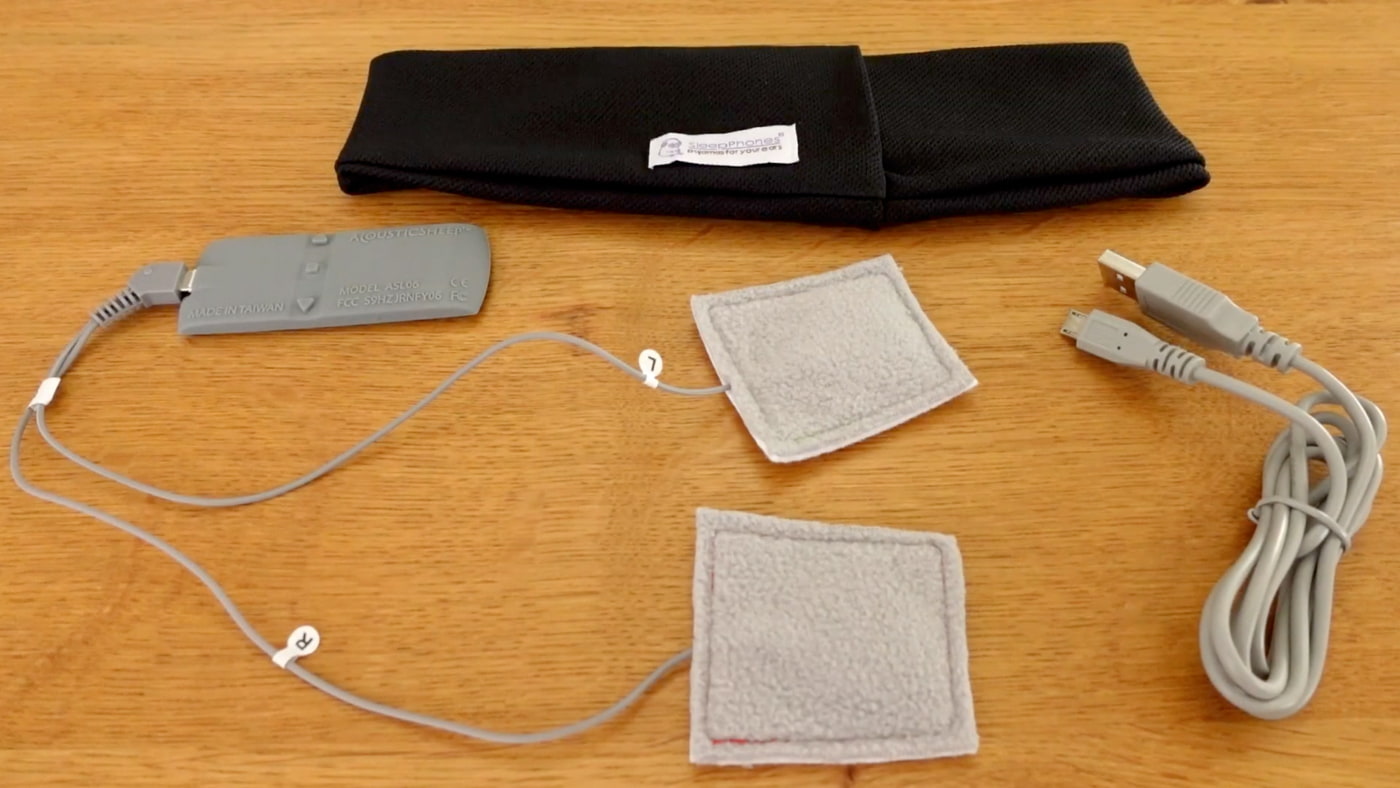
The polyester and spandex headband is both breathable and stretchy, and feels very comfortable to wear. The speakers are flat and encased in soft padded material. With the additional padding of the headband itself, they don’t put too much pressure on your ears and I find I can lie on my side or front comfortably.
The audio quality is decent for this style of headphones, but it’s definitely not as good as the Soundcore or Ozlo headphones. They don’t produce a lot of bass, but there’s enough to enjoy music quietly in bed without feeling like something is missing. In contrast, the budget headbands have even less bass and mids in my experience and tend to sound tinny.
Like all the headbands, they don’t have active noise cancellation and there’s no app with sleep masking sounds. The padding of the material combined with your choice of audio might help block out quiet snoring, traffic, or music in another room. But these are not headphones I would recommend if your main goal is to block out loud noise.
Another criticism is that the speakers can move out of place sometimes, so you may find you have to wiggle them back into position. It’s not a huge gripe, but it’s something to be aware of.
On balance, none of the headbands can compete with the sound masking, audio quality, or features of the Soundcore, Ozlo, or good standard headphones. But that’s not what they were designed for.
They sound clear enough for some quiet bedtime listening and they allow side and front sleepers to listen to music or podcasts who find sleep earbuds or normal headphones too uncomfortable to use. And the SleepPhones are the best of the bunch out of the many different audio headbands I’ve tried.
Price
The Bluetooth headband costs $99.95 in the US. The Effortless version, with an easier induction charger, costs $149.95. And the corded version with a standard 3.5mm jack costs $39.95. I’ve only tried the standard Bluetooth version though.
Read my full SleepPhones review and video for more information.
4. Apple AirPods Pro 3
Very effective active noise cancellation, but less practical for side sleepers
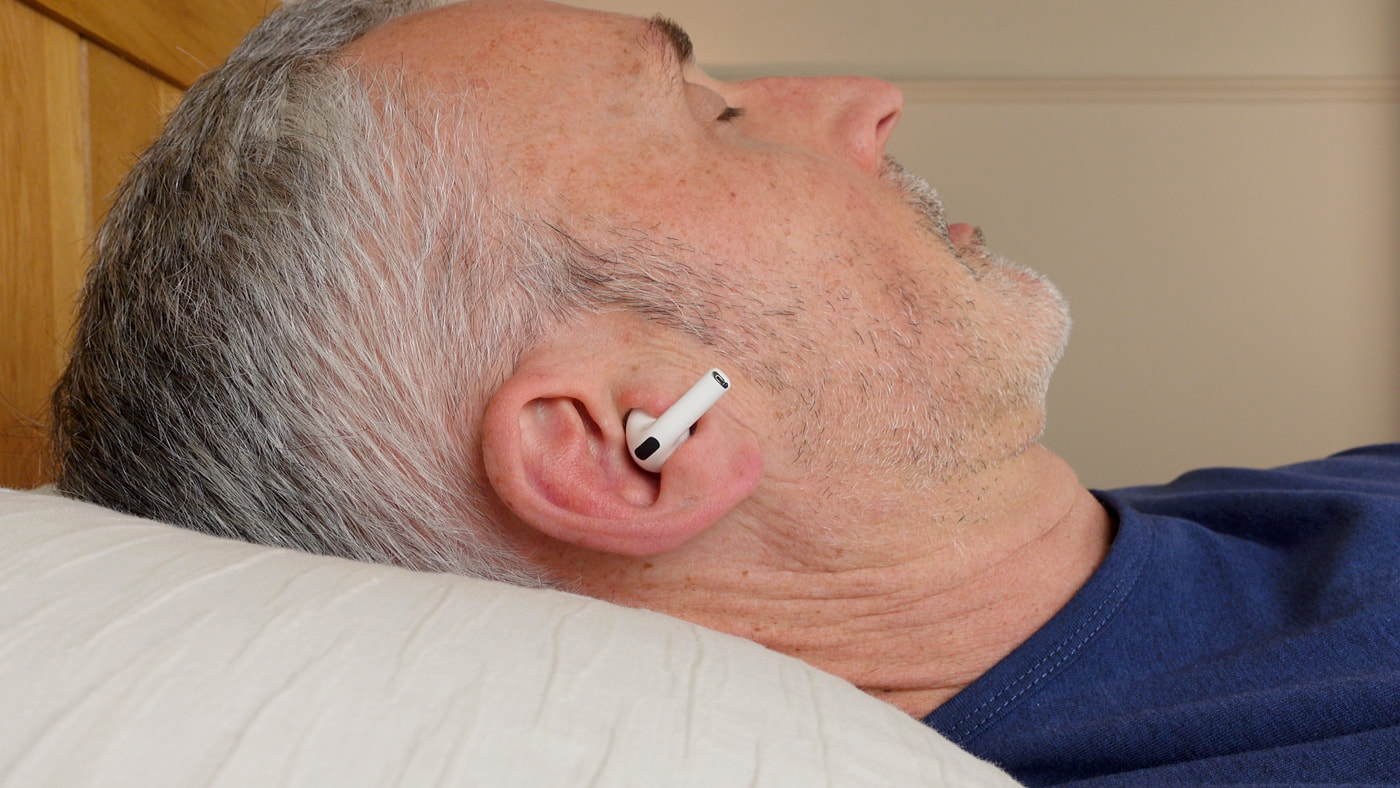
If you want the best active noise cancellation possible, there are many normal headphones that have better ANC than the Soundcore. When a company isn’t restricted by the need to make the earbuds small enough to use in bed, the shell can of course house more advanced tech.
Honestly, I could have chosen any number of headphones for this section, and so can you if you only plan on listening to audio for a while before removing the headphones, or if you somehow only sleep on your back.
I decided to include the AirPods Pro 3 though for a few reasons. They are the headphones I use myself during the daytime, mainly because I absolutely love how good their ANC is. I used the AirPods Pro 2 for a long time, and the Pro 3 are even better. I can stand right in front of my loud cooker vent fan, for example, and listen to an audiobook while cooking when the ANC is active.
I also use them when I travel, as I find they are very effective at blocking noise on planes, as well as trains or buses. If I want to get some sleep on a plane, these block out a lot of the background drone and even people talking. And they will do the same in bed at home if there is traffic noise or music coming from another room or house.
Now, if you’ve ever tried sleeping with any AirPods model before, you’ll know they aren’t ideal for side or front sleeping. Like the majority of standard headphones, they are simply too large, and the stem will press against your ear. Two ways around that problem are to use a pillow with a hole (they do work) or only sleep with one earbud.
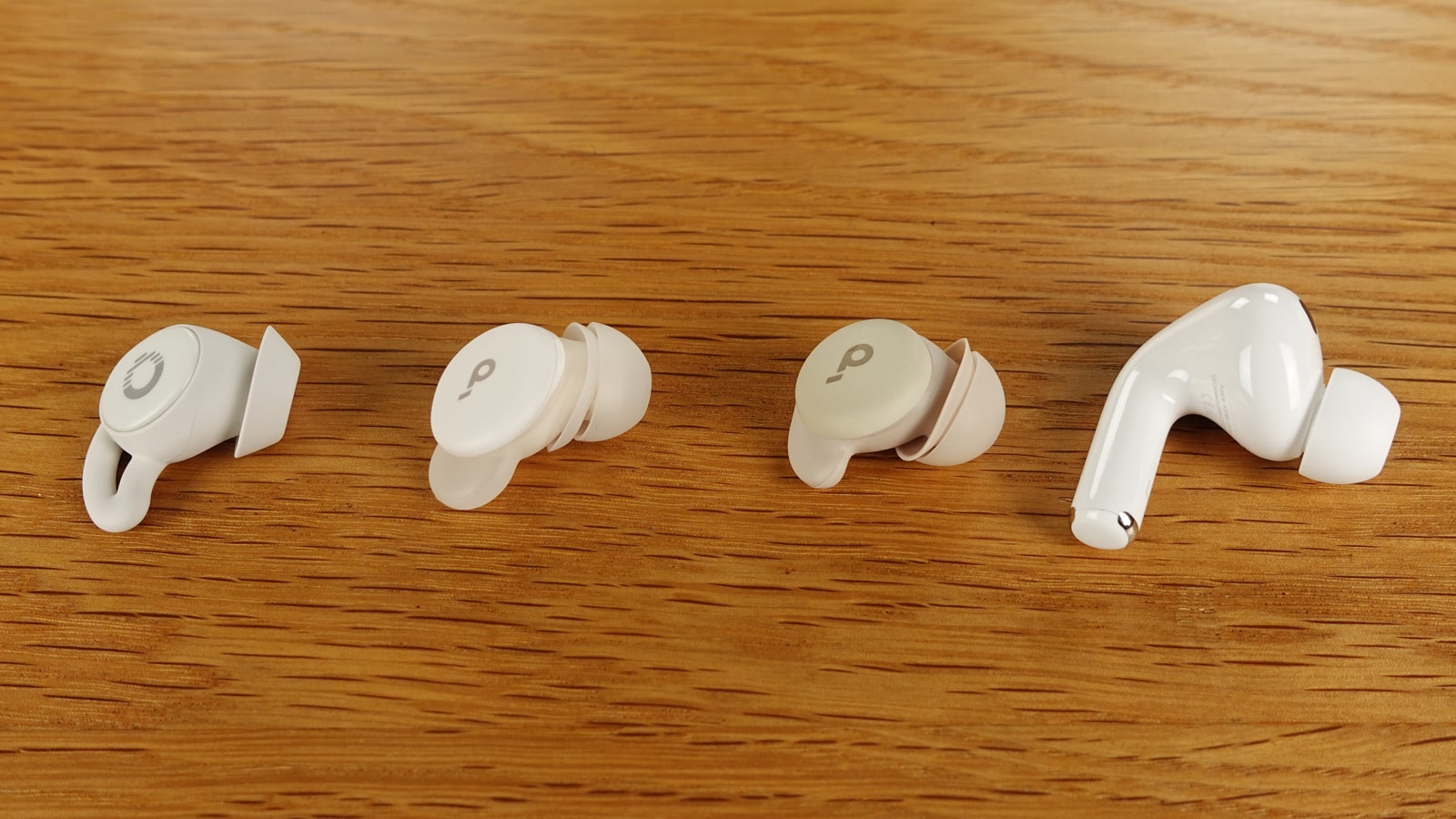
In the photo below, you can see how much larger the AirPods are than the three dedicated sleep earbuds in this review. From left to right: Ozlo Sleepbuds, Soundcore Sleep A20, Soundcore Sleep A30, Apple AirPods Pro 3.
However, if you know you’re on your back most of the night, or only want to listen to some calming music, podcast, or sleep sounds to unwind or block out some noise that’s really bothering you before popping them back in the case, then they are a viable option.
When it comes to the audio quality of high-end consumer headphones, it’s always a personal thing; I’m not saying that Apple makes better headphones than other companies. But while I’ve loved some Sony headphones in the past for their bass, for example, I prefer the clarity and ANC settings of the AirPods nowadays. But whatever your preference, most high-end headphones should generally have better audio quality than any of the sleep headphones.
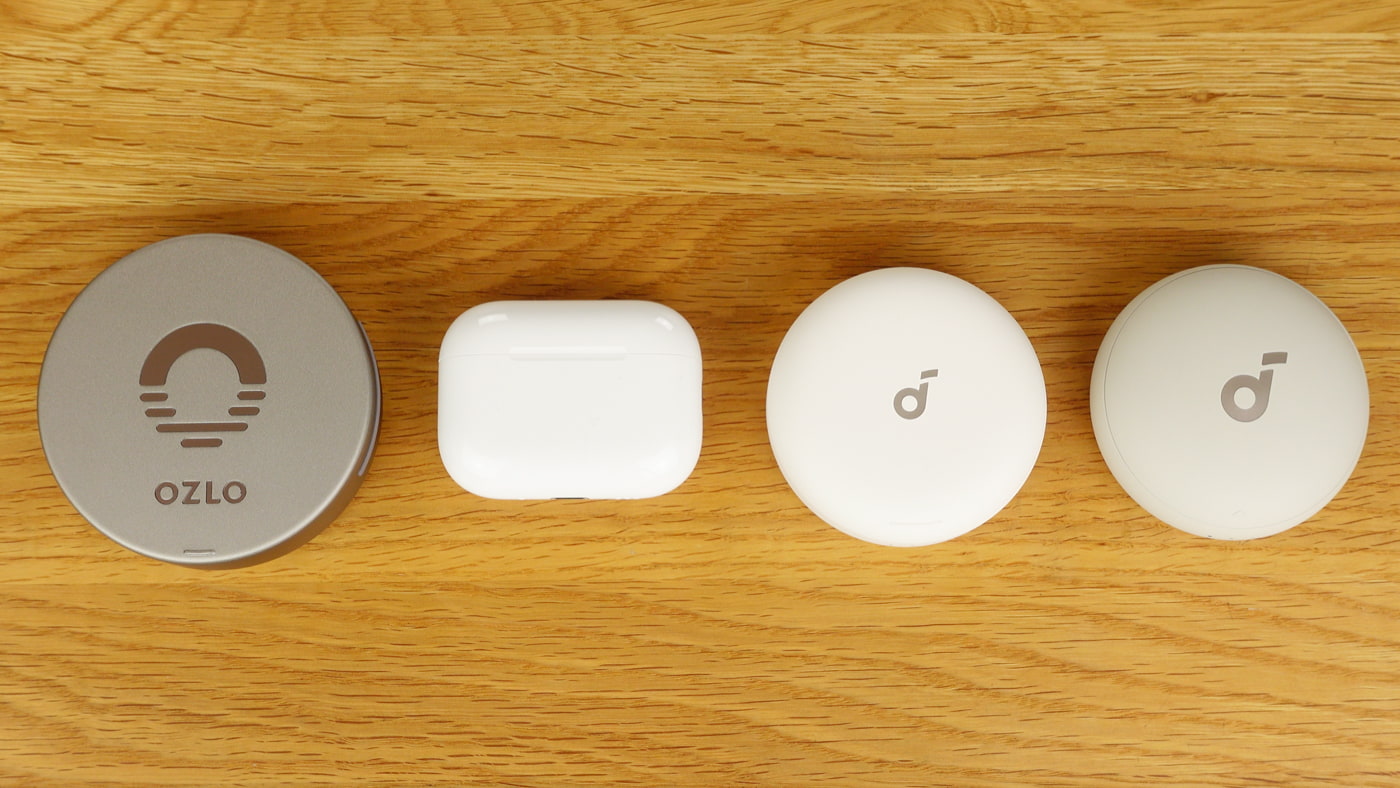
In the photo below, you can see how the cases compare. The AirPods Pro 3 may be larger earbuds, but the case is smaller, which is another reason I would use them for travel rather than any of the sleep headphones.
As for the battery life, the ANC of the AirPods Pro 2 wouldn’t last all night, which is a key reason many people didn’t use them for sleep. But I’ve found the Pro 3 last just under eight hours when I listen to music with ANC, which is enough for me. And they charge very quickly in the case if you do need to top them up on long trips, which is great.
There are some other interesting features, but one that’s useful in bed is the conversational awareness setting. With that active, it will automatically lower your audio and ANC when you talk to the person sharing your bed. It’s a small detail, but better than having to remove an earbud or earplug just to exchange a couple of sentences.
Price
The AirPods Pro 3 currently cost around $249 in the US, £219 in the UK, $329 in Canada, and €240 in the EU.
5. Musicozy
The best low-cost audio headband
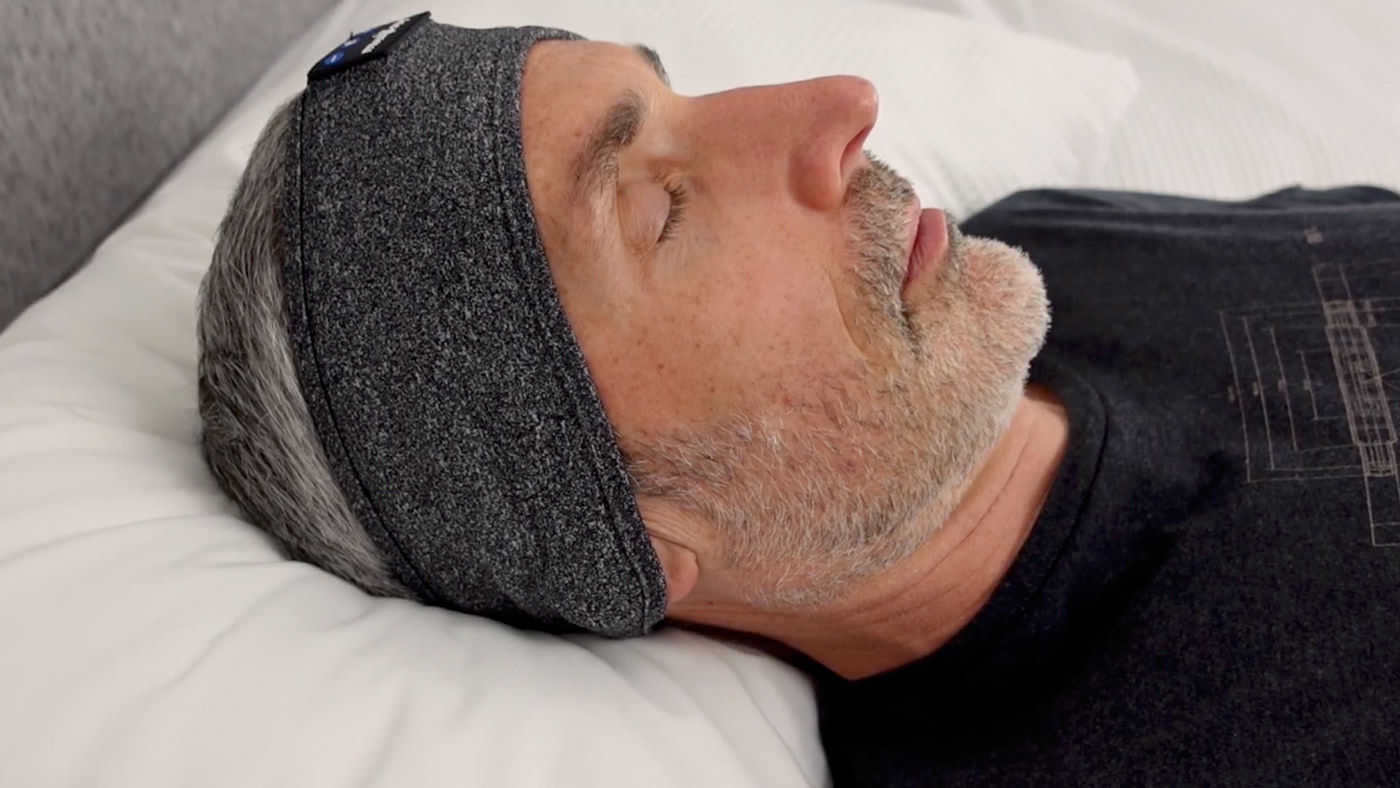
Above, I’m using the Musicozy. Like the SleepPhones, the headband has a control unit on the forehead. The speakers are thicker though, so you notice them more on your side.
The Musicozy are the best low-cost alternative to the SleepPhones I’ve tried. There are a lot of these headband styles floating around on Amazon, many of which look very similar. To find out more, I bought three new ones and although they do have a lot in common, there are also some differences in the design and the speaker quality.
The three I bought were the Musicozy, the Hanpure, and the Fulext sleep headphones. The material is visually similar, as is the control module that sits on the forehead when you wear them. There are a couple of reasons I prefer the Musicozy to the others though.
Firstly, there’s a small gap in the fabric where you can connect the micro-USB cable to the control module to charge it, which is more convenient than the design the other two have. And once it’s charged, I found it lasts for eight to ten hours, which is a decent amount of time.
The second reason is that the speakers are noticeably better. The Hanpure sound very cheap and thin, the Fulext are way too quiet and unnatural, and both have virtually no bass.
The Musicozy won’t exactly blow you away with their audio quality either, but it’s noticeably better. At the end of the day though, none of the budget headbands will sound as good as the SleepPhones or earbuds, so it’s a case of choosing the best of the bunch.
In the photo below, you can see the three low-cost headband style of sleep headphones I tested. From left to right: Hanpure, Musicozy, Fulext.
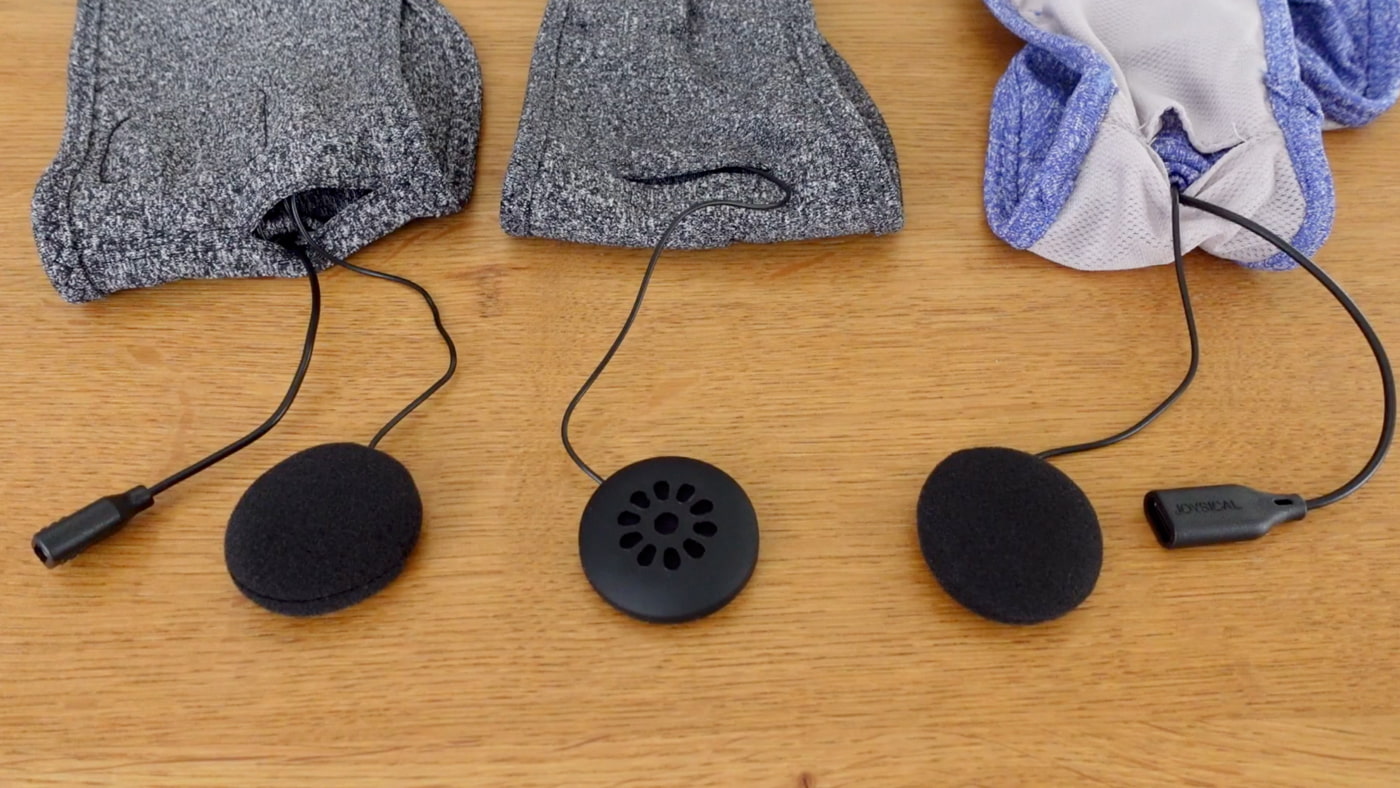
Importantly, the noise leakage was better with the Musicozy too, so nobody will hear much of your music unless you turn it right up. There’s no active noise cancellation and there’s not enough padding to block out external noise, so I wouldn’t recommend them if you need to mask external noise.
They are comfortable to wear in bed though, and I could use them when lying on my side for extended periods of time. Having said that, the speakers are thicker and less padded than the SleepPhones, so I don’t think they are ideal to wear on your side for the whole night.
Overall, the Musicozy are low cost headbands that might be all you need if you want a comfortable way to listen to music or podcasts quietly in bed. Just don’t have high expectations of the audio quality and be willing to have an obvious control panel on your forehead that turns you into a fabric android.
Price
They typically cost around $20 in the US, $20 in Canada, £20 in the UK, and €20 in the EU. Being a budget product sold mainly on Amazon, the price can go up or down depending on the time of the year though. I’ve seen them for as little as $15 in the US and as much as $25, for example.
6. Soundcore Sleep A20
Longer battery life and lower price than the A30
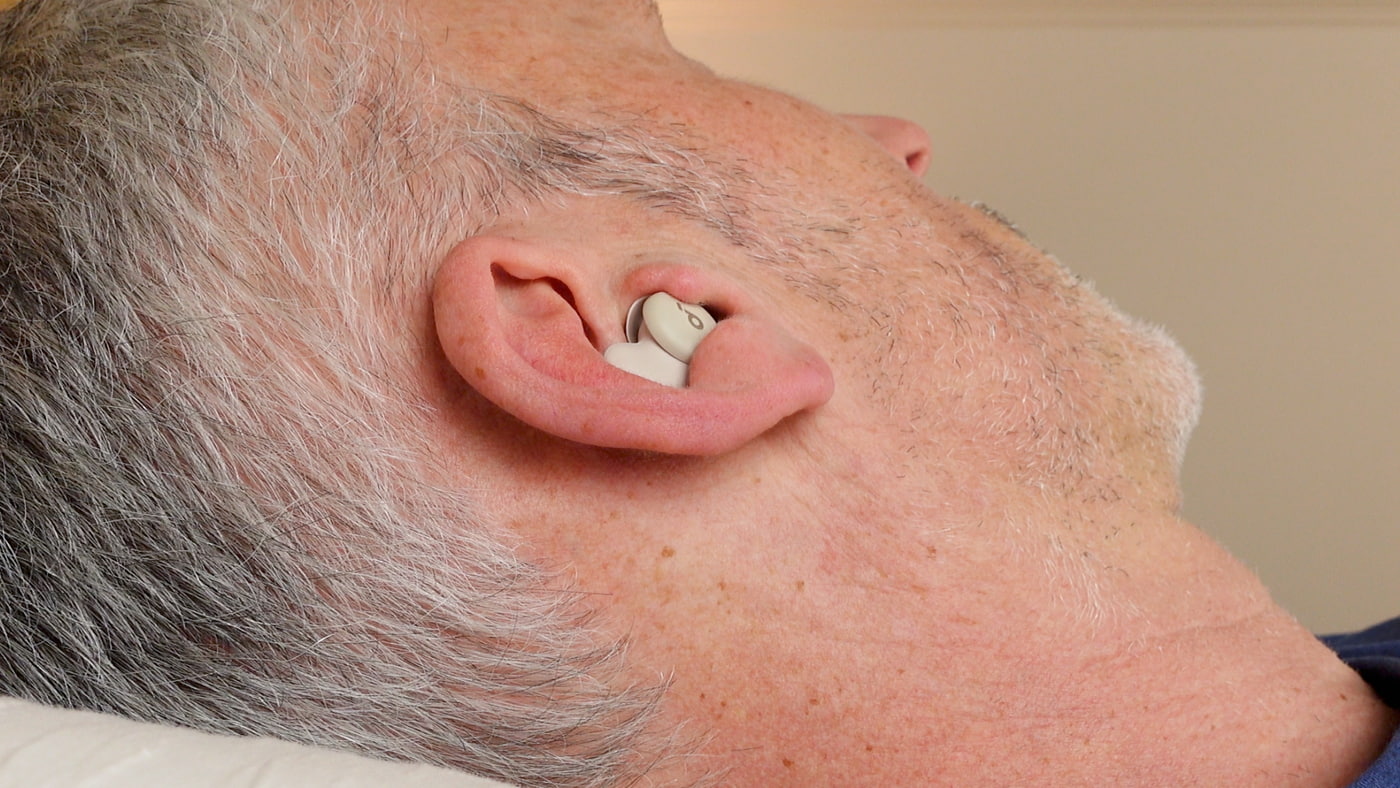
In the photo above, you can see that the Soundcore Sleep A20 sit fairly comfortably in my ear, but they are a bit larger than the A30 and the Ozlo.
I was initially hesitant to include the older Soundcore Sleep A20 model because I personally think the A30 are significantly better. However, there are still a couple of reasons to consider them.
One of the key differences is that the A20 don’t have active noise cancellation. But what they do have instead is longer battery life because there’s no ANC draining the earbuds.
Officially, Soundcore says you can get 9 hours from the original A30 in Bluetooth mode, and 10 hours with the A20. But as I mentioned above, when you have ANC activated, that 9 hours drops dramatically. Even the A30 Special struggle to last 10 hours with music playing and ANC active.
So if you do want to stream your own audio all night, and need the longest possible battery life, the A20 do give you that little bit extra even if the A30 don’t have the ANC on.
In the photo below, you can see the Soundcore Sleep A20 earbuds and case have some similarities to the A30 at first glance. However, the A20 don’t include memory foam tips, so the passive noise isolation is less effective. And the case doesn’t have an internal light to help you locate the earbuds in the dark, which is a feature I really like about the A30.
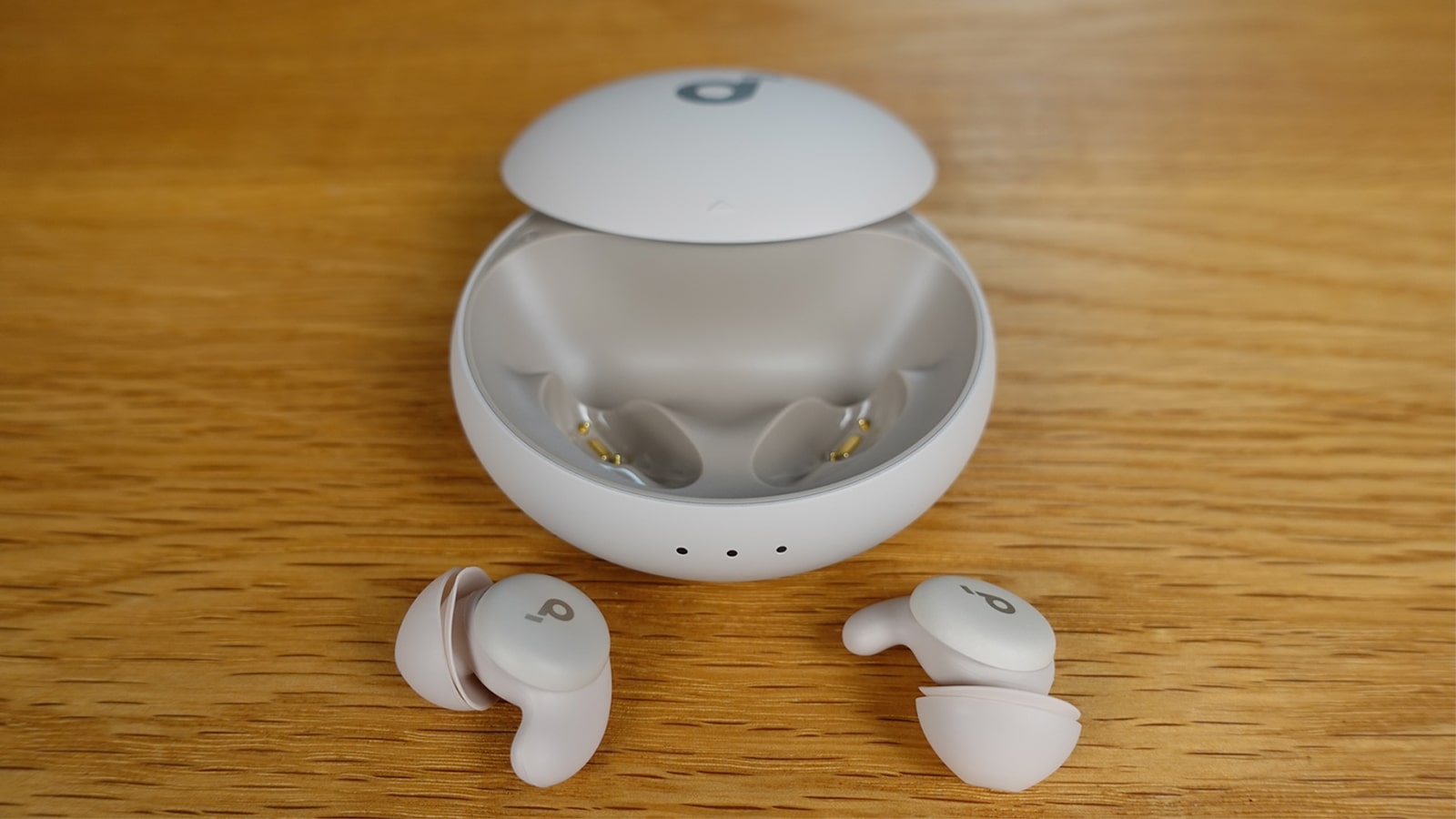
Another key reason the A20 could be a good option is the price. As you’d expect from an older model, the A20 cost less than the A30, and they are significantly cheaper than the Ozlo or AirPods.
That’s about it though, as the A30 improve on the A20 in every other way. Even though the A20 also have a wide range of sounds on the audio library, including my favourite starry sky AI brainwave audio track, the A30 just sound better overall.
I thought the A20 were great when I first reviewed them over a year ago, as they were the first dedicated sleep headphones that really impressed me – especially with how comfortable they are.
The A30 go a step further though, with a smaller design and thinner profile. It’s not a huge difference, but for side sleepers, even a small percentage decrease in the earbud size can make a big difference I think.
In the photo below, you can see arguably one of my more useful photos! I removed the tips and wings so you can compare the solid internal section of the three main sleep earbuds. Left to right: Ozlo Sleepbuds, Soundcore Sleep A30, Soundcore Sleep A20. It’s obvious the Ozlo is the smallest, while the A30 are just a touch smaller than the A20.
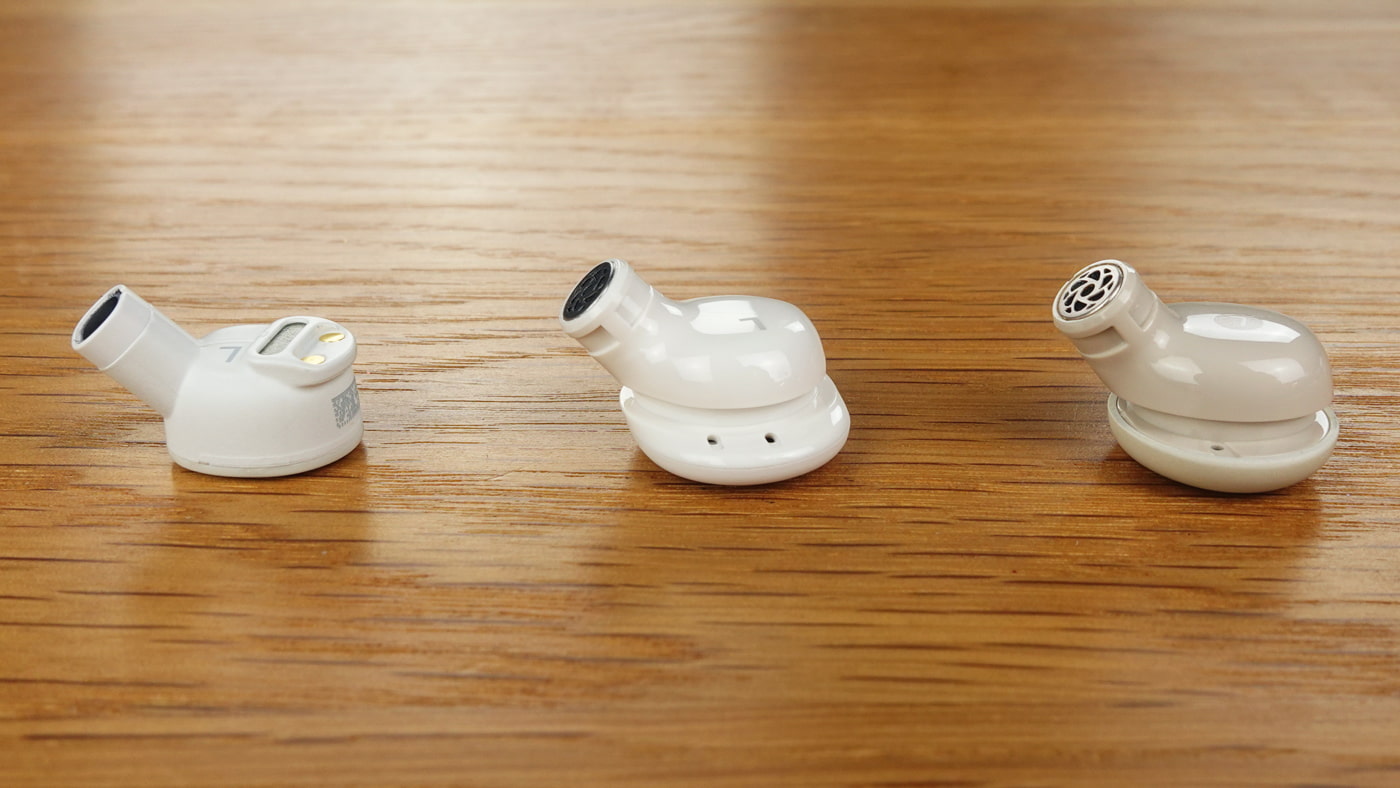
On balance, I still think the A20 are worth considering if you want to try some small sleep earbuds, and are either on a tighter budget or really need to squeeze as much juice out of the battery as possible. Otherwise, I’d stick with the A30 or Ozlo.
Price
They typically cost around $180 in the US, $199 in Canada, £119 in the UK, and just over €100 in the EU. Again, you may find discounted prices when you check Amazon.
Find out more in my full Soundcore Sleep A20 review and video.